Task Decomposition: How to Break Big Projects Into Daily Wins
The project that has been on the list for six weeks is not there because you lack the discipline to start it. It is there because it is too large to start as written. "Finish the business plan," "launch the website," "write the report" are not tasks. They are outcomes. An outcome is not something you do on a Tuesday morning. A task is. The gap between the two is exactly where avoidance lives, and task decomposition is the skill that closes it. Break any project into its component steps, give each step a specific time estimate and a named slot in the calendar, and the activation energy required to begin drops from intimidating to trivial. The project does not become easier. Starting it does.
Why Big Tasks Produce Avoidance
The psychological mechanism behind avoidance is well-documented. Large, open-ended tasks produce a specific type of aversive emotional response: the feeling of uncertainty about where to start, combined with the awareness that the task will require significant effort and the fear that the output will not meet the standard required. This cocktail of uncertainty and anticipated effort is what most men interpret as "not wanting to do it." It is not a preference. It is a cognitive response to an overwhelmingly large stimulus.
Roy Baumeister's research on self-regulation at Florida State University, whose work is documented at roybaumeister.com, has consistently shown that self-regulatory effort depletes across a day's worth of decisions. A task that sits on your list undecomposed forces a micro-decision every time you look at it: where do I start, how much time does this need, what does done look like? These micro-decisions cost self-regulatory resource even when you decide not to start. The accumulation is what produces the end-of-day feeling that you have been busy without having done the thing that mattered.
Task decomposition eliminates most of these micro-decisions at the planning stage rather than in real time. When you open the calendar on a Tuesday morning and the 9:00 slot says "Write section 2 of the business plan: competitive analysis, target 600 words," there is no decision to make. There is a task with a scope, a word count, and a time box. You sit down and begin. The activation energy collapses because the cognitive work of figuring out what to do has already been done.
The Decomposition Method: Breaking Any Project Down
Task decomposition has four levels and you move through them in sequence. Not all projects need all four levels. Complex multi-week projects need the full stack. A single-session task might only need the bottom two.
Level one is the outcome. The destination. "Launch the new product page" or "deliver the quarterly financial report." This is what most men write on their task list and stop at. It is useful for knowing where you are going and useless for knowing what to do today.
Level two is the phase breakdown. What are the major stages the project moves through? A product launch has a copy phase, a design phase, a technical setup phase, and a launch phase. A report has a data collection phase, an analysis phase, and a writing phase. Identify these phases and give each one a rough time estimate. You now have four to six milestones instead of one overwhelming endpoint.
Level three is the task list for the current phase. Within each phase, what are the specific tasks? Write them down as concrete actions with a clear completion state. "Write product description" is a task. "Gather data" is not. Be precise about what done looks like for each one.
Level four is the daily allocation. Take the tasks from level three and assign each to a specific day and time block in the calendar. This is where the decomposition produces its full value. The tasks move from a list on a page to named appointments in the week. A task with a named day and time block is five times more likely to happen than a task that lives on a general list, a figure consistent with Peter Gollwitzer's implementation intention research and the reason implementation specificity is the central recommendation in goal psychology literature.
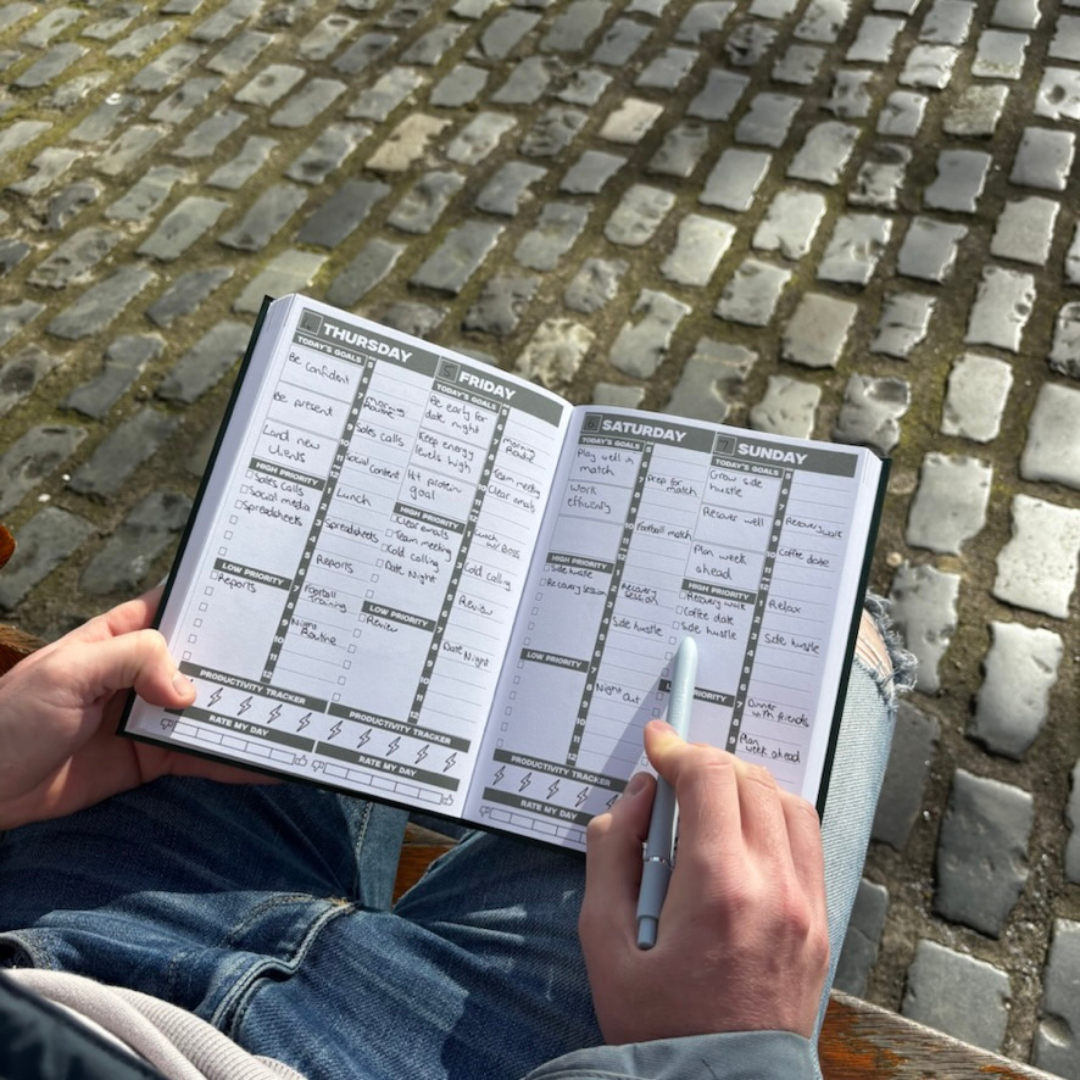
The Plan Your Growth undated weekly agenda is where level four happens. The daily layout gives each decomposed task a named home in the week, visible alongside your other commitments so you can see the realistic allocation rather than optimistically assuming more will fit than actually will.
The Time Estimation Problem (and How to Fix It)
Most men significantly underestimate how long tasks take. This is so consistent and so well-documented that it has its own name in cognitive psychology: the planning fallacy. Daniel Kahneman at Princeton University characterised it as the tendency to predict tasks will take less time and fewer resources than they actually do, even when the person has experience completing similar tasks.
The practical consequence for task decomposition is that your first pass at a time estimate is almost always too optimistic. A section of a report you estimate at one hour will often take ninety minutes. A design phase you estimate at two days will often take three. If you build a project plan on optimistic estimates and then execute against that plan, you spend the project in perpetual recovery mode from the schedule you never realistically built.
Two fixes. First, apply a 1.5x multiplier to your first estimate. If you think the task takes sixty minutes, block ninety. If you think the phase takes three days, allocate four and a half. This is not pessimism. It is calibration based on how the planning fallacy consistently operates. Second, keep a log of your estimates versus actuals for two weeks. This gives you personalised calibration data rather than a generic multiplier. Some men are slightly optimistic. Others are dramatically so. Your own data will tell you which you are.
Maintaining Momentum Across a Multi-Week Project
Task decomposition sets up the plan. Maintaining momentum through the execution is a separate skill, and it is where many men's projects stall even after a good decomposition session.
The mechanism that sustains momentum in a multi-week project is the weekly connection between the quarterly or project goal and the current week's task. Every Sunday planning session should include a brief project status check: are you on the phase you expected to be on? Is the current week's allocation sufficient to maintain the trajectory? If the project is running behind, this is when you identify the recovery and adjust the schedule. Not on Wednesday when the pressure is already building.
The daily minimum also applies to projects. On a day when the full planned task is not completable, the minimum viable version keeps the project alive. If the ninety-minute writing block gets cut to thirty minutes by an unexpected demand, thirty minutes of writing still moves the project forward. Partial execution beats zero execution every time, and maintaining the habit of engaging with the project daily means the re-entry friction the following morning is significantly lower.
How Task Decomposition Changes Your Relationship With Difficult Work
After six to eight weeks of consistently decomposing your projects before execution, something shifts. The category of "intimidating work" shrinks. Not because the work itself becomes less demanding, but because your brain has learned through repeated experience that the activation energy of beginning a well-decomposed task is low. The aversive anticipation that produces avoidance is calibrated against what beginning a task actually costs, and with a decomposed task, it costs almost nothing.
This is the compounding benefit of task decomposition that most productivity writing misses. It is not just a project management technique. It is a way of training your brain to associate the start of difficult work with a simple, low-friction action rather than an overwhelming cognitive event. Over time, the avoidance response to large projects becomes less automatic and the response of breaking them down and beginning becomes the default.
The Bottom Line
Task decomposition closes the gap between the project on your list and the work that gets done today. Break every significant project from outcome to phase to task to daily allocation. Apply a time multiplier to your estimates. Check project status in the Sunday planning session and adjust when you are running behind. Run the minimum viable version when the full session is not available. Do this consistently and the list of things you are actively avoiding will shrink, not because the work gets easier but because you stop treating overwhelmingly large items as tasks and start treating them as projects that have already been broken into things you can begin.
The Plan Your Growth undated weekly agenda is where the decomposed task gets a named home in the week. Not on a list. In a slot. With a scope and a time. That specificity is the difference between a task you intend to do and a task that happens.