The 12 Week Year: A Faster System for Hitting Goals
Most annual goals are dead by the second week of February. Not because the goals were wrong, but because a year is too long a horizon for the human brain to treat as urgent. The 12 week year, a framework built by Brian Moran and Michael Lennington, solves this by throwing out the calendar year entirely and replacing it with twelve-week cycles, each one treated with the urgency most men only bring to the last quarter of December. This is not another goal-setting theory. It is a mechanical fix for a well-documented failure of human motivation, and it is exactly the kind of system that turns intention into execution.
Why a Full Year Kills Momentum
A twelve-month goal gives your brain permission to procrastinate. If you have fifty-two weeks to hit a target, week three feels indistinguishable from week thirty. There is no real urgency until the deadline is close enough to feel, and by the time it feels close, you have already burned the runway you needed to actually hit it.
The 12 week year collapses that runway on purpose. Twelve weeks is short enough that every week matters and long enough to build real momentum, not just a sprint. You cannot coast in week four of a twelve-week cycle the way you can coast in month four of a twelve-month plan. The clock is loud the entire time.
This isn't just a mindset shift. It changes the actual mechanics of how you plan. Instead of an annual goal broken into vague quarterly checkpoints, you get one focused execution period with a hard start and a hard end, followed by a new one. Four "years" inside a single calendar year, each one a full, urgent cycle.
The Three Pillars of the System
Vision. Before you touch a single tactic, you need clarity on what you are actually building toward, beyond this one cycle. A 12 week year without a longer vision behind it just becomes a sequence of disconnected sprints. The vision is what makes the twelve weeks feel like they belong to something bigger than themselves.
The 12 Week Plan. This is where the vision gets broken down into specific, measurable goals for the cycle, and those goals get broken down further into weekly tactics. Not vague intentions like "get in better shape." Specific and measurable: three strength sessions a week, one long run, macros logged five days out of seven. If a goal cannot be turned into a weekly action, it does not belong in the plan yet. It needs more definition first.
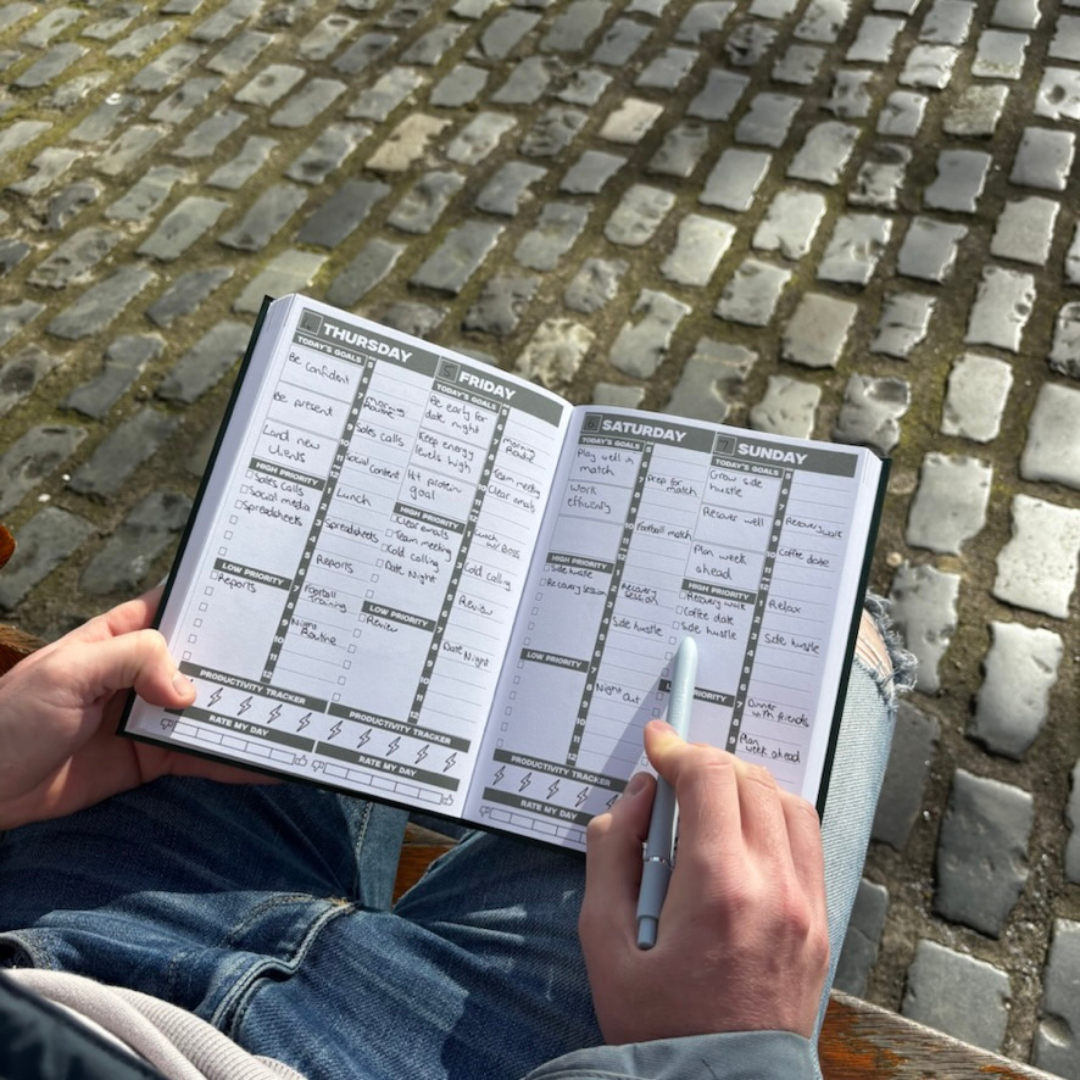
The Weekly Execution. Every week of the cycle gets its own plan, drawn directly from the twelve-week goals. This is where most men's system actually breaks down, not at the annual planning stage but at the weekly one, because weekly planning requires a habit of sitting down on the same day, at the same time, and doing the work of translating a big goal into this week's specific actions. This is exactly the mechanism the Plan Your Growth undated weekly agenda is built to support: a fixed weekly review slot, a place to write this week's priorities against your bigger goal, and no printed dates forcing you to wait for January to start.
Scoring Yourself Honestly
The 12 week year framework includes a weekly execution score: the percentage of your planned weekly tactics you actually completed. This single number is more useful than any amount of reflection on whether you "feel" like you are making progress, because feelings lie and a completion percentage does not.
Most men who run this for the first time are shocked by how low their execution score is in week one and two, even when they feel busy. That gap between busy and effective is the entire point of tracking it. An honest execution score in the 60 to 80 percent range in early weeks, trending upward as the cycle continues, is a far better signal than a vague sense that things are going fine.
Track it weekly, not just at the end of the cycle. A score you only calculate in week twelve tells you nothing you can act on. A score you calculate every Sunday, alongside your weekly review, gives you a live read on whether the plan needs adjusting before the cycle is over, not after.
Common Mistakes in a First Cycle
The most common mistake is setting too many goals for a single twelve-week cycle. Two or three well-defined goals executed with real weekly discipline will outperform six vague ones every time. Pick fewer targets and go deeper on each one.
The second mistake is treating week one like a warm-up. There is no warm-up in a twelve-week cycle. Week one needs the same intensity as week eleven, because the entire premise of the system depends on urgency starting immediately, not building gradually toward a deadline that still feels far away.
The third is skipping the weekly review when the week gets busy, which is precisely when it matters most. A missed review does not just cost you that one week's reflection. It breaks the feedback loop that lets you adjust before a small miss becomes a pattern. Researchers studying goal pursuit, including work associated with psychologist Angela Duckworth on grit and sustained effort, consistently find that the difference between people who hit long-term goals and people who do not is rarely raw talent. It is the consistency of the follow-through system underneath the goal.
Running Your First 12 Week Year
Start by picking a start date this week, not the first of next month. The entire point of the system is urgency, and waiting for a symbolically clean start date undermines that from day one.
Write your vision in one paragraph: not a list of goals, a description of the direction. Then choose two or three goals for the cycle that clearly serve that vision. For each goal, list the weekly tactics that will move it forward. Be specific enough that you could hand the list to someone else and they would know exactly what to do each week.
Every Sunday, sit down with the Plan Your Growth undated weekly agenda and translate the twelve-week goals into this week's specific actions. At the end of each week, score your execution honestly. At the end of the twelve weeks, review the full cycle before you start the next one: what worked, what you overestimated, what you will change.
Adapting the System to a Demanding Job
Men with unpredictable, high-demand jobs often assume a structured twelve-week cycle can't survive contact with their actual schedule. The system adapts better than it looks like it should, provided the weekly tactics are scoped to your real available hours rather than an idealized version of your week. The mistake is not the framework. It's setting weekly tactics that assume a calmer week than the one you actually have.
Build a buffer into the plan from the start: if you genuinely have five hours a week available for a given goal, plan tactics that require four, not six. The twelve-week cycle survives busy stretches far better when the weekly targets were realistic from day one, rather than optimistic ones that get quietly abandoned the first time a demanding week arrives. A goal that gets hit at ninety percent of an honest target beats one that gets abandoned entirely because the target assumed a version of your week that doesn't exist.
Running Multiple Goals Without Losing Focus
Most 12 week year guidance recommends two to three goals per cycle, and that range exists for a specific reason: fewer goals means each one gets a genuinely useful share of your weekly capacity, while more than three tends to dilute focus back toward the same scattered-effort problem the system was built to solve in the first place.
If you are running goals across separate domains, career, health, relationships, resist the instinct to treat them as fully independent. A demanding week on the career goal will pull energy away from the others whether you plan for it or not. Build in an implicit hierarchy: know which goal takes priority if a week genuinely cannot support all three at full intensity, so that trade-off gets made deliberately in advance rather than reactively in the moment, under pressure, when the decision quality is at its lowest.
Why the Cycle Length Itself Matters
Twelve weeks is not an arbitrary number chosen for tidiness. It sits at a length long enough to produce real, measurable progress on a meaningful goal, but short enough that the end is always visible from the start, which is precisely what keeps urgency alive for the full duration rather than only the final stretch. A six-week cycle is often too short to build real momentum on anything substantial. A six-month cycle drifts back toward the same complacency problem that made a full calendar year unworkable in the first place. Twelve weeks has been tested extensively by the framework's originators specifically because it sits at that narrow, effective middle ground.
This is also why the transition between cycles matters more than most people initially treat it. A one-week gap between cycles, used deliberately for review and planning the next twelve weeks, prevents the burnout that comes from running cycle after cycle with no pause, while still being short enough that momentum doesn't fully dissipate before the next cycle begins.
When to Abandon a Cycle Entirely
Occasionally a twelve-week cycle needs to be cut short, a genuine life disruption, an illness, a major unplanned event. This is different from a normal difficult week and deserves a different response. Rather than limping through a compromised cycle to its nominal end and recording a discouraging score, it's often more useful to formally close the cycle early, note honestly what was learned, and start a fresh twelve weeks once circumstances allow real execution again. A cycle abandoned deliberately, with a clear reason recorded, protects the system's credibility for next time. A cycle that quietly fizzles without ever being formally closed tends to make the next cycle harder to start with real conviction, because the last one never got a clean ending.
The Bottom Line
The 12 week year works because it removes the false comfort of a distant deadline and replaces it with a horizon short enough to stay urgent for the entire cycle. Pick two or three goals, break them into specific weekly tactics, score your execution honestly every week, and start now instead of waiting for a cleaner date on the calendar. The system only works if the weekly planning happens every week without exception, which is a discipline problem before it is a strategy problem.
The Plan Your Growth undated weekly agenda was built for exactly this kind of cycle. No printed dates means you can start your first 12 week year today, not on the next arbitrary Monday, and the weekly layout gives you the structure to turn a big goal into this week's actual tasks, every single week of the cycle.