The 12-Week Year: Why Quarterly Goals Beat Annual Ones
Most annual goals die in exactly the same way. January brings real intensity, March brings a plateau, and by June the goal has quietly become background noise, something you still technically believe in but no longer actually act on with any urgency. The 12-week year is a system built specifically to prevent that collapse. It treats twelve weeks as a full year, with its own real deadline, so the urgency that normally only shows up in the final weeks of December gets applied to every single quarter instead.
The system was originally built for sales teams, where quarterly targets already created this same compressed urgency by necessity. Applied to personal and professional goals more broadly, the same mechanism holds. A deadline twelve weeks away is close enough to feel real on an ordinary Tuesday, which a deadline eleven months away almost never manages to do.
Why a Twelve Month Deadline Produces Twelve Months of Procrastination
A year is long enough that almost any amount of delay still feels recoverable. Miss a week in February and there are still ten months left. Miss a month in the spring and summer still feels like plenty of time to catch up. This is exactly the problem. Tim Pychyl, whose research on procrastination has shaped how a lot of men understand their own avoidance, has found that urgency, not willpower, is usually the actual driver behind sustained action, and a twelve month deadline simply does not generate enough of it until the final weeks arrive.
The 12-week year solves this by compressing the deadline. Twelve weeks is long enough to make real progress on a meaningful goal, but short enough that a missed week actually registers as a real loss rather than a forgivable blip. That shift in perceived urgency is the entire mechanism behind why the system works, more than any specific planning template layered on top of it.
This also explains why so many men hit their goals in December and nowhere else during the year. The deadline finally became real. The 12-week year simply moves that same end of year intensity into every quarter, four times a year instead of once, so the actual output of a full year compounds across four genuine pushes instead of one rushed one.
Notice, too, how differently a project feels in its final two weeks compared to its middle stretch. The same person who coasted through March suddenly works with real focus in the two weeks before a deadline. The 12-week year is an attempt to make that final-two-weeks energy available far more often, rather than treating it as a rare state that only shows up under genuine pressure at the very end.
Setting Up Your First 12-Week Cycle
Start by choosing a small number of goals for the cycle, ideally no more than three. A 12-week year loaded with ten goals dilutes the urgency the system depends on, spreading your attention too thin to generate the focused intensity that makes the compressed timeline actually work. Three real goals, tracked weekly, beats ten vague ones tracked occasionally.
Choose goals you can actually influence on a weekly basis, rather than ones dependent entirely on outcomes outside your control. A revenue target influenced by market conditions is harder to track honestly than the specific weekly actions, calls made, proposals sent, that actually drive toward it. Track the actions you control. Let the outcome follow from consistent execution of those actions.
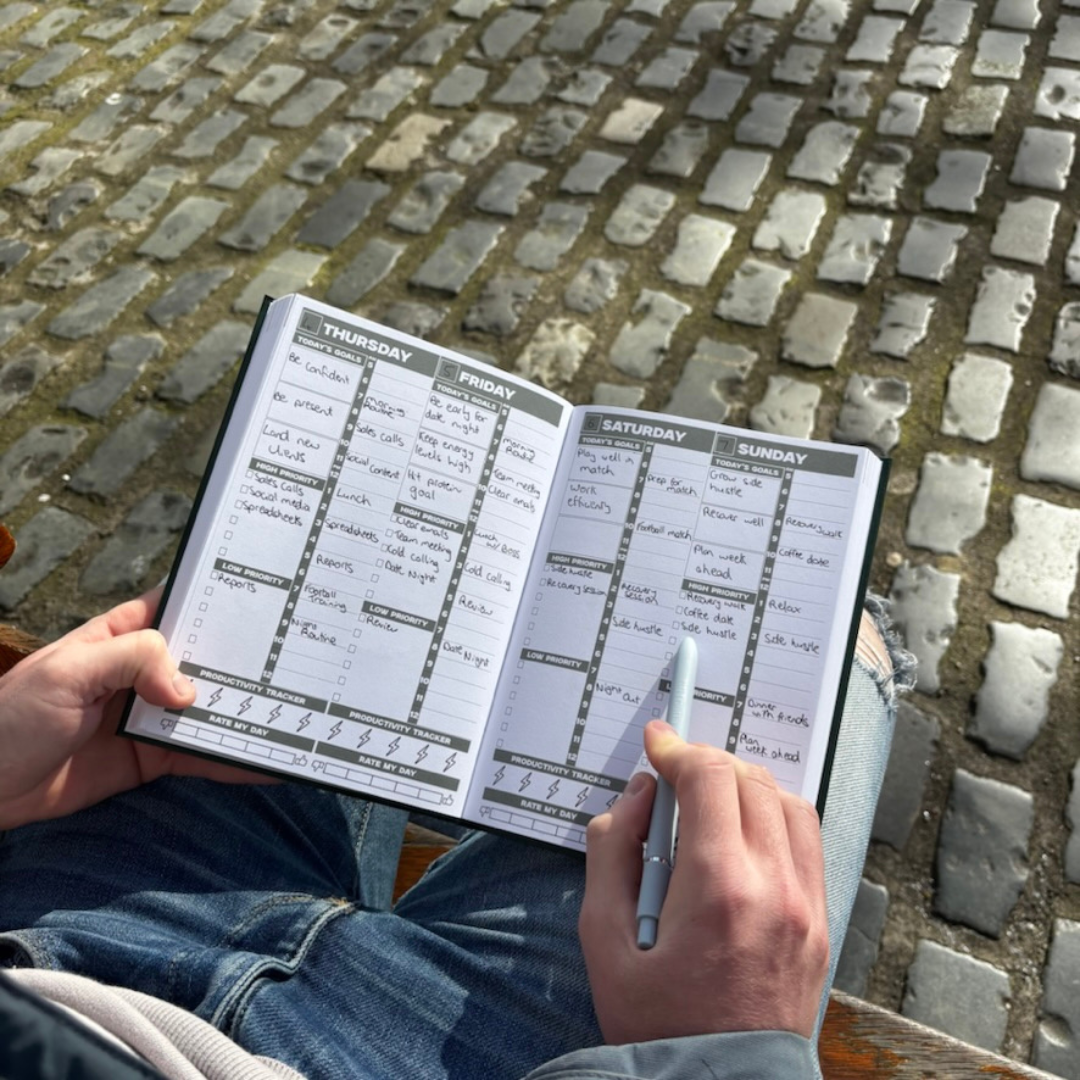
Break each goal down into weekly actions rather than a single twelve week target sitting far in the distance. Write the weekly actions directly into your Plan Your Growth undated weekly agenda, so each week has a specific, concrete task attached to the larger goal rather than an abstract intention to "work on it at some point." A goal broken into weekly actions is a plan. A goal left as a single distant target is a wish.
Set a hard review date for the end of the twelve weeks before the cycle even starts, and treat that date with the same seriousness as any external deadline. The entire system depends on that end date feeling real, not flexible, because a 12-week year with a soft, movable deadline simply becomes a slower version of the same annual drift it was built to replace.
Mark the review date somewhere visible, not buried in a planner page you only open occasionally. A date you see regularly keeps the twelve week window present in your mind in the same way a looming annual deadline naturally does in late December, which is precisely the effect the entire system depends on to work.
The Weekly Scorecard That Keeps the Cycle Honest
The 12-week year runs on a weekly scorecard, a simple tally of whether you did or did not complete your planned actions for the week. This is not about measuring the outcome of the goal itself, which is often too slow moving to track weekly. It is about measuring your execution, the thing you actually control day to day, regardless of how the larger outcome is currently trending.
Keep the scorecard brutally simple. A checkmark or a blank box for each planned action, reviewed during your weekly reset. The simplicity is deliberate. A complicated tracking system becomes its own project, one that quietly competes with the actual goal for your limited attention and discipline.
Review your execution percentage honestly each week rather than only focusing on the final outcome. A string of weeks at sixty percent execution is a clear, early signal that something about the plan itself needs adjusting, the actions were too ambitious, the time allotted was unrealistic, before the full twelve weeks are wasted waiting for an outcome that the weak execution was never actually going to produce.
Resist the urge to inflate the scorecard to protect your own ego. A partially completed action marked as done defeats the entire purpose of tracking execution in the first place. The scorecard is only useful because it is honest, and an honest seventy percent is far more valuable information than a dishonest one hundred that hides exactly where the plan actually broke down.
Why the Reset Between Cycles Matters as Much as the Cycle Itself
Many men run their first 12-week cycle well and then immediately roll straight into the next one without a real reset, carrying over whatever momentum or burnout the previous twelve weeks produced. This skips one of the most important parts of the system. A short, deliberate reset between cycles, a few days to review, recover, and choose the next set of goals properly, prevents the system from quietly becoming just as exhausting as the annual grind it replaced.
Use the reset to genuinely evaluate whether the previous cycle's goals were the right ones, not simply whether you hit them. A goal completed perfectly but aimed at the wrong target is not actually a win, and the reset is where that distinction gets made before you commit another twelve weeks to the same wrong direction.
Build recovery into the reset explicitly rather than treating rest as something that only happens if time happens to be left over. A man who runs four genuinely intense twelve week cycles back to back without any recovery between them tends to burn out by the third one, undermining the entire system's long term value in exchange for short term intensity that does not actually compound.
A few days of genuinely lighter structure between cycles is not wasted time. It is what makes the next cycle's intensity sustainable rather than a slightly weaker repeat of the last one, running on fumes from a recovery that never actually happened.
Applying the System Beyond Work Goals
The 12-week year is most commonly used for career or business goals, but the same compressed urgency works just as well for fitness, financial, or personal goals that have historically died the same slow annual death. A fitness goal given twelve weeks and a weekly scorecard tends to produce far more consistent training than the same goal given a full year and a vague intention to "get back into it."
Run no more than one or two 12-week cycles at a time across different areas of your life, rather than trying to apply the system everywhere simultaneously. The urgency the system creates is valuable precisely because it is limited and focused. Spread across every domain of your life at once, it tends to produce the same diluted effort the system was designed to prevent in the first place.
Choose which domain gets a 12-week cycle based on what currently matters most, and let other areas run on a lighter, more maintenance-oriented system in the meantime. Not everything in your life needs this level of compressed intensity at the same time, and trying to run all of it that way is a reliable way to burn out before the first cycle even finishes.
If an area of your life is already running well on autopilot, leave it there. The 12-week year is a tool for areas that are currently stuck in the annual drift pattern, not a replacement for every single system already functioning adequately on its own.
The Bottom Line
The 12-week year works because it manufactures real urgency on a timeline short enough to sustain it. Three focused goals, broken into weekly actions, tracked with an honest scorecard, and followed by a genuine reset before the next cycle begins. A year does not fail because the goals were wrong. It fails because a twelve month deadline rarely feels real until the final weeks force the issue, by which point there is rarely enough runway left to actually fix it.
Open your Plan Your Growth undated weekly agenda and set your first 12-week cycle this week. Three goals, broken into weekly actions, with a hard deadline twelve weeks from today. Treat it like it is already December, because that is the entire point of the exercise, and the urgency you manufacture now is what actually carries the work through the ordinary weeks in between.