The Daily Shutdown Ritual: End Your Workday With Intention
Your workday does not end when you close the laptop. It just changes location, following you to dinner, into your workout, and onto the couch, replaying half-finished tasks and tomorrow's problems while you try to be present with the people in front of you. Most men never actually shut down. They just stop typing. The daily shutdown ritual is a five-minute practice that closes the day properly, so work stays at work and your evening actually belongs to you.
Why Your Brain Refuses to Clock Out
The reason work follows you home has a specific psychological mechanism behind it. Psychologist Bluma Zeigarnik's research, now known as the Zeigarnik effect, found that unfinished tasks occupy more mental space than completed ones, creating a kind of background cognitive tension that persists until the task is either finished or deliberately captured somewhere your brain trusts. Most workdays end with a dozen unfinished loops, an email half-drafted, a decision half-made, a project with tomorrow's next step undefined, and your mind keeps quietly working on all of them in the background because none have been properly closed.
This is why you can physically leave the office and still feel like you never left. The tasks are not finished, and more importantly, your brain has no confirmation that they are safely captured somewhere. Without that confirmation, it keeps the tabs open, running low-level processing on problems you thought you had walked away from hours ago.
The daily shutdown ritual works by giving your brain that confirmation directly. It is not about finishing everything. It is about explicitly telling your mind that everything unfinished has been captured, accounted for, and will be handled tomorrow, which is often enough to let the background processing finally stop.
The Five-Step Shutdown Sequence
Step one: review what got done. Two minutes, scanning what you actually completed today against what you planned. This is not for self-congratulation or self-criticism. It is data, the same way an athlete reviews game film, building an accurate picture of your real output instead of the vague sense of having been "busy all day" that tells you nothing useful.
Step two: capture every open loop. Every unfinished task, every half-formed idea, every decision you are still sitting on. Write it all down, without organizing or prioritizing yet. This is the step that does the actual cognitive work, since an open loop written down stops occupying the same mental space as one still floating in your head.
Step three: identify tomorrow's first task. Before you close the day, decide the single most important thing tomorrow needs to start with. Not the whole day's plan, just the first move. This removes the morning decision of "what do I even start with," which otherwise burns willpower you need for actual execution.
Step four: say the shutdown phrase. This sounds unusual until you try it. Cal Newport, who has written about this specific technique, recommends a fixed verbal or mental phrase, something as simple as "shutdown complete," said deliberately at the end of the ritual. The specificity matters. A vague sense of being done is not the same as a defined signal your brain can learn to trust as the actual end of the workday.
Step five: close the physical and digital workspace. Laptop closed, work notifications silenced, workspace tidied if that matters to you. This is the physical reinforcement of the mental shutdown, giving your environment the same clear boundary your mind just established.
Why the Written Capture Matters More Than the Phrase
Of the five steps, the written capture in step two is doing the heaviest lifting, and skipping it is the most common reason the shutdown ritual fails to actually quiet a racing mind. Saying "shutdown complete" without having genuinely captured the open loops is asking your brain to trust a signal it has no real reason to believe. The written list is what earns that trust.
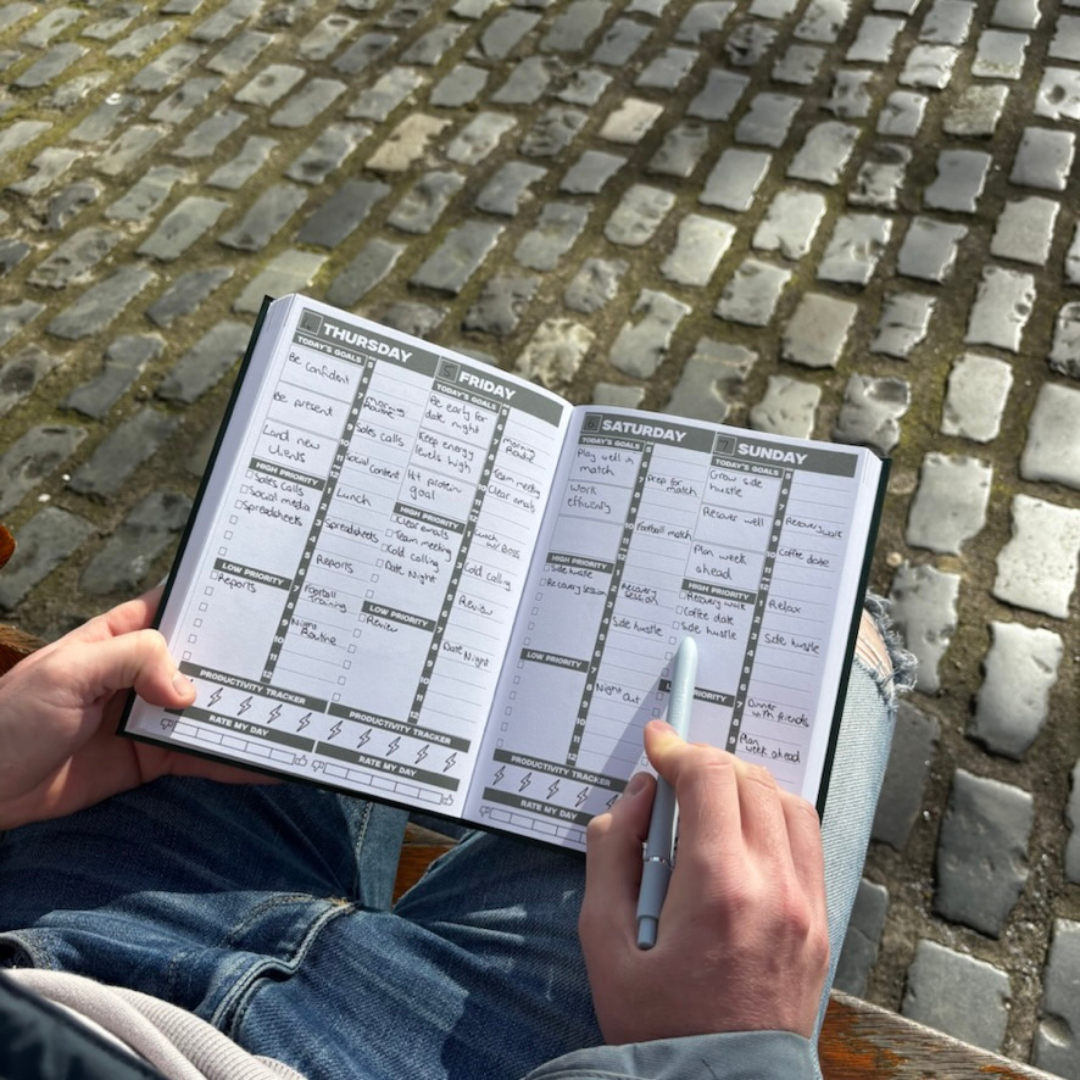
This is also why the shutdown ritual works better as part of a broader weekly planning system than as an isolated evening habit. If your captured open loops from tonight have nowhere reliable to live, no clear place they will actually be reviewed tomorrow, some part of you keeps worrying they will be lost or forgotten regardless of how firmly you write them down. The Plan Your Growth undated weekly agenda gives that captured list a real home, a page you will genuinely return to the next morning, which closes the loop far more completely than a scrap of paper you might not see again.
What Happens the First Two Weeks
Like most habits worth building, the daily shutdown ritual feels slightly artificial the first several times. Saying a fixed phrase out loud, or even just deliberately, can feel unnecessary when you are already tired and ready to be done. Push through this. The ritual is training a new association, laptop closed plus captured list plus fixed phrase equals the workday is genuinely over, and associations take repetition to build, not a single attempt.
By the second week, most men report the phrase itself starting to carry weight, a genuine mental exhale rather than an empty gesture. This mirrors the general pattern of habit formation research, where a new behavior often feels effortful and slightly forced for roughly two to three weeks before it starts running with less conscious effort.
Protecting the Evening You Just Earned
The shutdown ritual closes the workday, but protecting the evening that follows requires one more deliberate choice: not reopening work channels once the ritual is complete. This sounds obvious and is genuinely difficult in practice, especially with a phone that makes checking email as easy as checking the time. If a work notification pulls you back in twenty minutes after your shutdown, the ritual's entire value gets undone in a single glance.
Consider a hard boundary here, notifications off after a certain hour, work apps moved off your home screen, whatever removes the temptation to casually check "just for a second." The shutdown ritual creates the closing. This boundary is what keeps it closed.
The Bottom Line
Work does not end when you stop typing. It ends when your mind gets confirmation that every open loop is captured and accounted for, which is exactly what the daily shutdown ritual provides in five deliberate minutes. Review what got done, capture every open loop, name tomorrow's first task, say a fixed closing phrase, and shut the physical workspace. Do this every day for two weeks and notice how much more of your evening actually belongs to you.
The Plan Your Growth undated weekly agenda gives your captured open loops a real place to live overnight, so tomorrow morning starts with clarity instead of a scramble to remember what you meant to do. Close the day properly. Get your evening back.