The Daily Shutdown Ritual That Protects Tomorrow's Momentum
You close the laptop at 6pm and by 6:45 you are still mentally drafting the email you should have sent, still running the unresolved problem from the 4pm meeting on a loop while your family is talking to you at dinner. Closing the laptop is not the same as ending the workday. A daily shutdown ritual is the ten minute mechanism that actually tells your brain the day is finished, and it is the difference between an evening you are present for and one you spend half absent from.
Why Closing the Laptop Does Not End the Workday
Your brain does not know the day is over just because a physical action, closing a screen, has happened. What actually signals completion to your nervous system is confidence that nothing important has been dropped, that tomorrow has a plan, and that the open loops from today have somewhere safe to live overnight. Without that confidence, your brain keeps low level tabs open, checking, rehearsing, worrying, right through dinner and often into the middle of the night.
This is the same mechanism behind unfinished tasks lingering disproportionately in memory, a well documented psychological effect where incomplete goals stay more cognitively active than completed ones, regardless of their actual importance. Closing a laptop does nothing to resolve that activation. Only a deliberate closing process does.
Building the Ten Minute Shutdown
The shutdown ritual has three parts and takes roughly ten minutes, no more. First, review what actually got done today against what you planned, not to judge yourself, but to close the loop honestly. Second, capture anything unresolved, an email that needs a reply tomorrow, a decision still pending, a task that got bumped, somewhere it will not be forgotten. Third, set tomorrow's first three priorities before you leave, so tomorrow starts with a decision already made rather than one you have to make cold at 8am.
Cal Newport, who coined the term shutdown ritual in his work on deep focus, argues that the ritual's real function is not organizational but psychological: it gives your brain explicit permission to stop thinking about work because every open loop has a documented next step, which is what actually allows disengagement, not the mere passage of time after closing a laptop (calnewport.com). Without that explicit closing, your brain treats the workday as unfinished business regardless of the clock.
Say a closing phrase to yourself if it helps make the ritual concrete, something as simple as "shutdown complete." It sounds unnecessary until you notice how much it helps mark a genuine transition, the same way a specific phrase or action can mark the start of a workout or a meditation session.
Where the Shutdown Ritual Lives
The shutdown ritual needs a physical home, not a mental one. If the three parts of the ritual, review, capture, and tomorrow's priorities, exist only in your head, you have not actually closed anything, you have just decided to stop thinking about it, which rarely works for more than twenty minutes before the thoughts resurface.
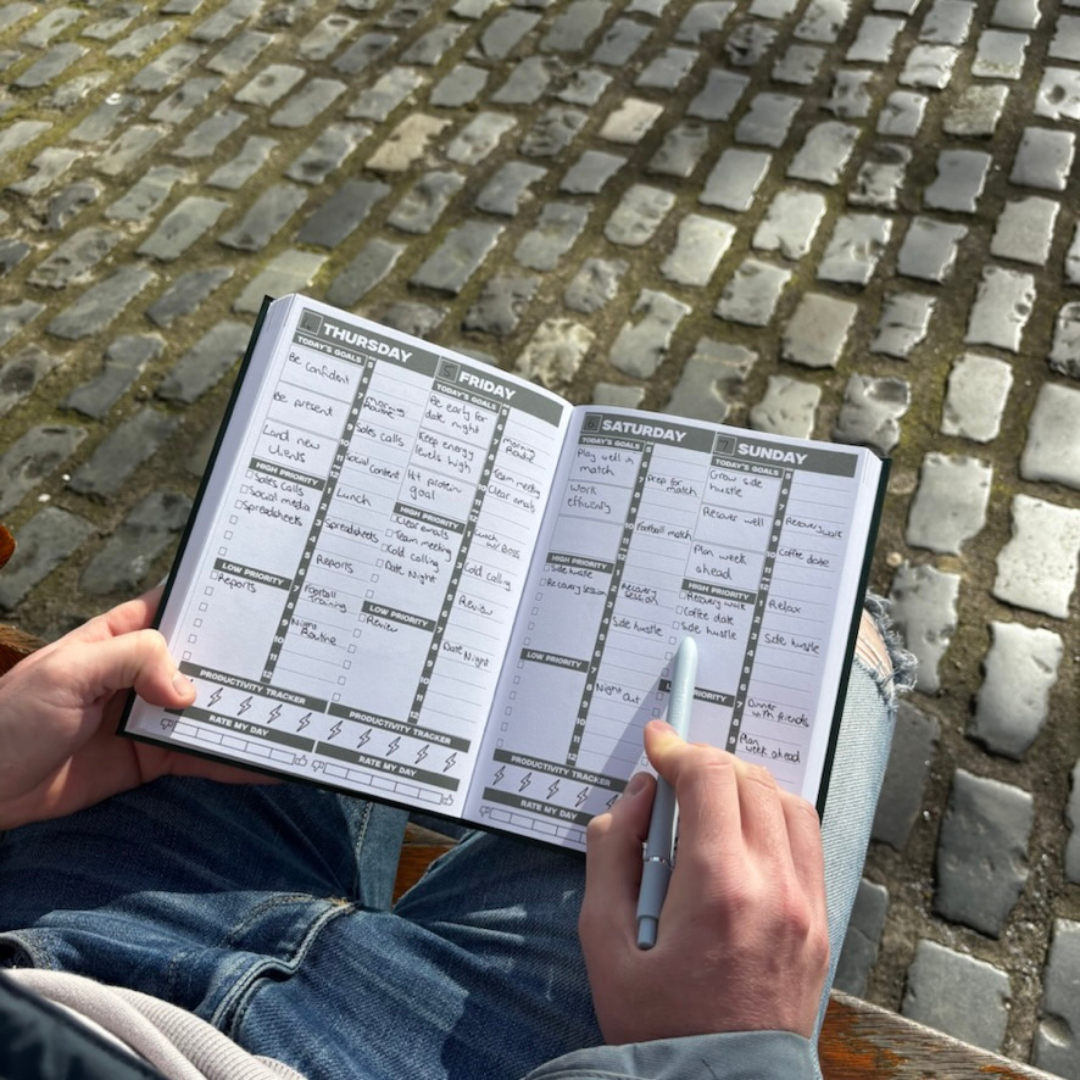
The <a href="/products/plan-your-growth-undated-weekly-agenda">Plan Your Growth undated weekly agenda</a> gives the shutdown ritual an actual page to run on. Use the daily section to check off what got done, note what carries forward, and write tomorrow's top three before you close it for the night. The physical act of closing the agenda after writing tomorrow's priorities becomes its own signal, a closing motion that mirrors the mental closing you are trying to achieve.
An undated structure matters here too. A shutdown ritual you missed for three days because of travel or a crisis should not feel like a broken streak. You pick the ritual back up the next available evening, without a calendar page reminding you of the days you skipped.
What Happens on the Days You Skip It
Some evenings the shutdown ritual will not happen, a late meeting runs past your usual close, an emergency at home takes priority the moment you walk in the door. Skipping it occasionally is not a system failure. The system failure is deciding the ritual only counts if you do it perfectly every day, and abandoning it the first time you miss.
On nights you skip the full ritual, do the abbreviated version: just capture the single most important open loop and just write tomorrow's first priority. Two minutes of a partial shutdown still beats zero minutes of a perfect one you talked yourself out of because you did not have the full ten.
Why the Ritual Matters More on Your Hardest Days
It is tempting to skip the shutdown ritual precisely on the days you need it most, the days that ran long, that included a difficult conversation, that left three things unresolved. This is exactly backwards. The harder the day, the more open loops your brain is carrying into the evening, and the more the ritual's function, converting vague unresolved tension into a specific documented plan, actually matters.
On a genuinely hard day, the shutdown ritual might take fifteen minutes instead of ten, because there is more to capture and more decisions about tomorrow that need to get made. That additional five minutes is a good investment, not a sign the ritual has become too heavy, since the alternative is carrying an undocumented, unresolved hard day directly into your evening and likely into a worse night's sleep.
Some men find it useful to separate a hard day's shutdown into two parts: an immediate five minute version done right when work ends, just enough to capture the most pressing open loops, followed by a fuller version done an hour later once the immediate stress has settled slightly. This staged approach prevents the ritual itself from feeling like one more demand piled onto an already difficult day.
Building the Ritual Into a Team or Household Signal
If you manage other people, consider building a lightweight version of the shutdown ritual into your team's rhythm as well, a two minute end of day note on what got done and what carries forward. This does for a team what the individual ritual does for you: it prevents open loops from silently rolling over day after day without anyone tracking them explicitly.
At home, a version of this can work too. A brief end of day exchange with a partner, what happened today, what tomorrow needs, serves a similar closing function at the household level, reducing the number of logistics conversations that otherwise happen in fragments throughout a tired evening instead of once, deliberately, at a set time.
Distinguishing a Real Shutdown From a Distracted One
Not every closing of the laptop counts as a shutdown, even if you go through the physical motions. If you review your task list while half distracted, scrolling a phone at the same time, the ritual loses most of its actual effect, because the mental closure the ritual is designed to produce depends on genuine attention during those ten minutes, not just the appearance of having done it.
Treat the shutdown ritual with the same seriousness you would treat a short but important meeting. Phone away, full attention on the review, capture, and tomorrow's priorities, for the few minutes it actually takes. A distracted version done out of habit rarely produces the sense of genuine closure that makes the rest of the evening feel different, which defeats the entire purpose of building the ritual in the first place.
A useful test is noticing whether work thoughts still surface unprompted an hour after the ritual. If they do consistently, that is a signal the ritual itself was rushed or distracted rather than a sign the method does not work for you, and the fix is protecting those ten minutes more deliberately, not abandoning the practice.
Give the ritual a fixed spot in your day, ideally tied to a physical action like closing a laptop lid or leaving a specific desk, rather than a loose intention to do it "before dinner." A ritual anchored to a specific, repeatable moment is far more likely to survive a hectic week than one that depends on remembering to fit it in somewhere.
Expect the first two weeks to feel mechanical, like you are going through the motions without much payoff. This is normal for almost any new closing habit. The psychological benefit tends to compound over three to four weeks of consistent practice, once your brain has genuinely learned to trust that the ritual reliably captures what needs capturing, at which point the sense of relief starts arriving faster and more reliably each evening.
Measure the effect the way you would measure any other system, by paying attention to your own evenings over a full month rather than judging after a single try. Most men who commit to the ritual report the clearest change not in how they feel at the moment of shutdown, but in how much faster they fall asleep and how much less residual tension shows up in ordinary family time later that night.
The Bottom Line
A daily shutdown ritual protects tomorrow's momentum by giving your brain the explicit closure it needs to actually stop working, reviewing what got done, capturing what did not, and setting tomorrow's first three priorities before you leave for the day. Ten minutes, done consistently, prevents the low grade mental residue that quietly eats into every evening you have not deliberately closed, whether that residue shows up as a racing mind at midnight or simply a nagging distraction over dinner. The next action is direct: tonight, before you close the laptop for good, spend ten minutes running the shutdown and see how different your evening feels.
An open loop with nowhere to land follows you home every time. The Plan Your Growth undated weekly agenda gives your shutdown ritual a real page to close on, so the workday actually ends when you decide it does, not whenever your mind eventually gets tired enough to let it go.