The Eisenhower Matrix: A Simple System for What Actually Matters
Most task lists fail for one reason. Everything on them looks equally urgent, which means nothing actually is. President Eisenhower reportedly said that what is important is seldom urgent, and what is urgent is seldom important, a distinction most men never apply to their own daily list. The Eisenhower Matrix fixes this by forcing every task through a simple, four-quadrant filter before it earns a place on your schedule, separating what genuinely matters from what just happens to be loud today.
Where This Framework Actually Came From
The matrix takes its name from Dwight Eisenhower, a five-star general and later a two-term president who managed an almost impossible volume of competing demands throughout his career. He did not leave behind the two-by-two grid diagram itself, that was formalised later by Stephen Covey in his work on personal effectiveness, but the underlying principle traces directly to a distinction Eisenhower drew repeatedly between things that scream for attention and things that actually matter. Understanding this origin matters because it reframes the tool correctly. This is not a modern productivity gimmick, it is a distillation of how someone managing genuinely enormous stakes structured decisions under real pressure, which is exactly the kind of pedigree that should make a man take the framework seriously rather than dismissing it as another passing productivity trend.
The Four Quadrants, Explained Properly
The Eisenhower Matrix sorts tasks along two axes: urgent versus not urgent, and important versus not important. Quadrant one is urgent and important, the genuine crises and hard deadlines that demand immediate action. Quadrant two is important but not urgent, the strategic work, planning, and relationship-building that actually moves your life and career forward, but rarely screams for attention. Quadrant three is urgent but not important, other people's priorities disguised as your own emergencies, a message that feels pressing but does not actually advance anything you care about. Quadrant four is neither urgent nor important, pure distraction, and it deserves to be cut without ceremony.
The insight most men miss is that quadrant two, not quadrant one, is where a genuinely well-run life actually happens. A life spent entirely reacting to quadrant one is a life in permanent crisis mode, and permanent crisis mode is usually a sign that quadrant two work, the planning and prevention that would have stopped the crisis, was neglected weeks or months earlier.
Handling Quadrant Four Without Guilt
Quadrant four, neither urgent nor important, gets a bad reputation in most productivity content, treated as pure waste to be eliminated entirely. This is an overcorrection. A small, deliberately bounded amount of quadrant four time, genuine rest, entertainment with no productive agenda attached, is not a failure of discipline, it is a normal part of a sustainable week. The actual problem is not that quadrant four exists, it is that it tends to expand silently to fill far more time than intended, crowding out quadrant two in the process. Naming a specific, bounded amount of quadrant four time in advance, rather than letting it quietly consume whatever time is left over, keeps it in its proper, minor place instead of letting it become the default way an entire evening gets spent.
Why Quadrant Three Is the Real Trap
Quadrant three is where most wasted days actually happen, because tasks here masquerade as urgent, a ringing phone, an incoming message, a colleague's request, while providing almost no real value to your own goals. The urgency is genuine. The importance, to you specifically, usually is not. Cal Newport, whose research on deep work and attention has shaped how a generation of professionals think about focus, has written extensively about how reactive, quadrant-three-style work crowds out the deliberate, valuable work that actually builds a career, precisely because urgency hijacks attention regardless of underlying importance.
Learning to recognise a quadrant-three task in the moment, urgent-feeling but not actually important to your own priorities, is the single highest-leverage skill the Eisenhower Matrix teaches. Most men have never been taught to ask the second question, importance, at all. They only ever ask the first, urgency, and urgency alone is a terrible filter.
Applying the Matrix to Other People's Requests
A specific application worth naming directly: the Eisenhower Matrix works just as well applied to incoming requests from other people as it does to your own generated task list. A request arriving with urgency attached, a colleague needing something "right now," should still pass through the importance filter before it earns a spot ahead of your own quadrant two work. This does not mean ignoring genuine emergencies from others, quadrant one is quadrant one regardless of who generated it. It means refusing to automatically treat someone else's urgency as your own importance by default, which is precisely the mechanism by which quadrant three quietly consumes entire days for men who have never learned to separate the two.
Running the Matrix on Your Actual Week
Applying the Eisenhower Matrix in practice starts with a five-minute sort during your weekly planning session. List every task on your radar for the coming week, then place each one into its quadrant honestly, resisting the instinct to mark everything urgent and important simply because it is on your mind. Quadrant one tasks get scheduled immediately, into the earliest available slot. Quadrant two tasks get deliberately blocked, not left to "whenever there's time," because whenever-there's-time rarely arrives on its own. Quadrant three tasks get delegated, declined, or handled with the minimum viable effort. Quadrant four tasks get cut outright.
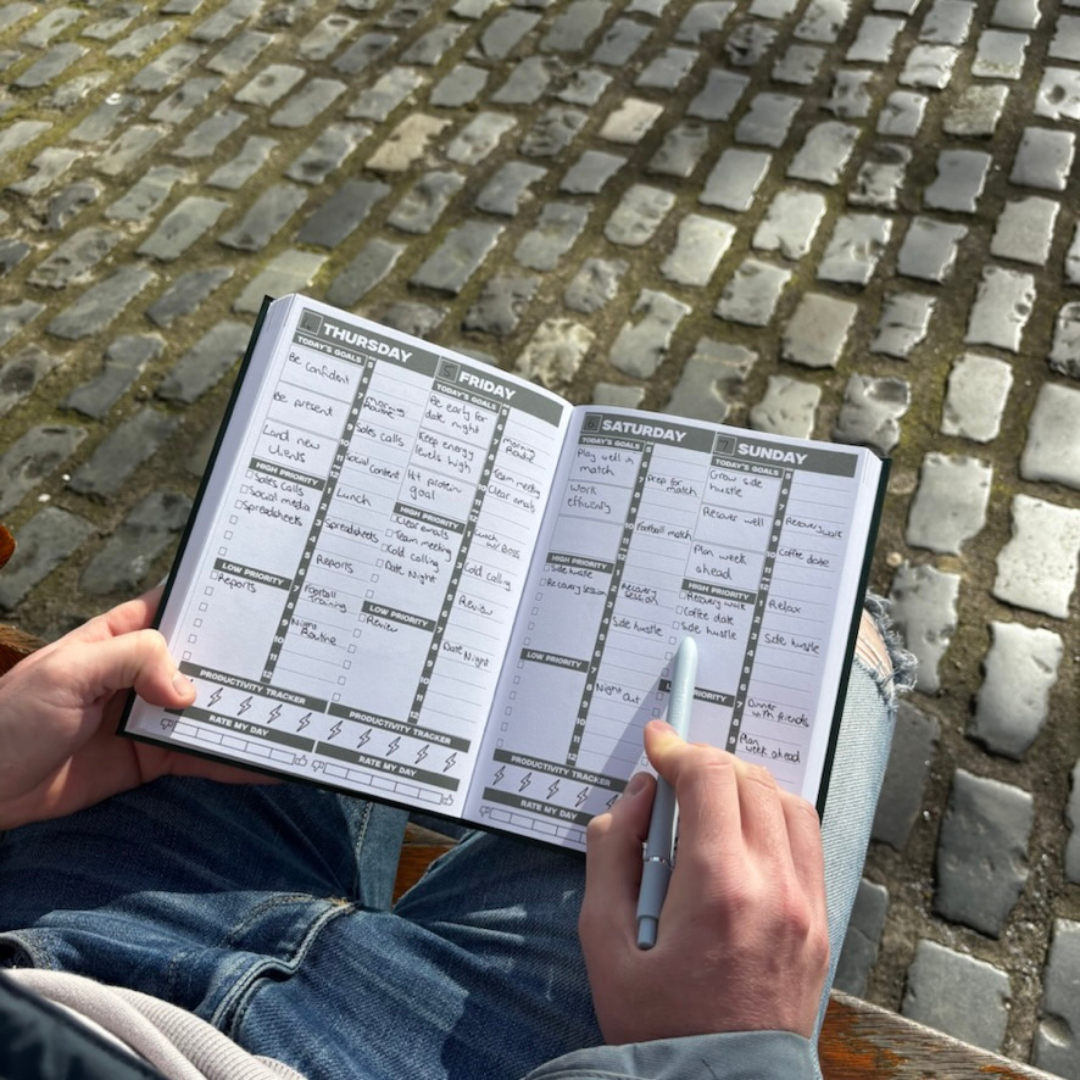
This sort fits naturally into the same weekly rhythm as the rest of your planning inside the Plan Your Growth undated weekly agenda, where the quadrant-two work, the genuinely important but rarely urgent priorities, gets a real, protected block rather than being pushed aside by whatever feels loudest that particular morning.
Protecting Quadrant Two From Everything Else
The single hardest discipline in the entire framework is defending quadrant two time against the constant pull of quadrant one and three. A blocked quadrant-two session will get challenged repeatedly by things that feel urgent in the moment, and giving in every time means the important work never actually happens, only gets postponed indefinitely in favour of whatever felt more pressing that day. Treating a quadrant-two block with the same non-negotiable weight as an unmissable meeting, rather than a flexible suggestion that yields to the first interruption, is what actually makes the matrix work in practice rather than just on paper.
Reviewing the Sort Weekly, Not Just Once
The Eisenhower Matrix is not a one-time exercise, it needs re-running every week, because what counted as quadrant one last week may have resolved, and what was quadrant two may now be approaching a genuine deadline and shifting into quadrant one. A weekly re-sort, done during the same session as the rest of your planning, keeps the categorisation honest and current, rather than relying on a stale sort from three weeks ago that no longer reflects reality.
The Bottom Line
The Eisenhower Matrix works because it forces a second question most men never ask about a task: not just is this urgent, but is this actually important. Sort every task into one of the four quadrants, protect quadrant two with real, defended blocks, and re-run the sort weekly rather than trusting an outdated one. The men who consistently execute on what matters are rarely working harder than everyone else, they are simply working from a more honest sort of what deserves their attention in the first place.
Build your weekly sort directly into the Plan Your Growth undated weekly agenda, where quadrant two finally gets the protected block it has been losing to quadrant three for years.