The Evening Shutdown Routine That Actually Ends Your Workday
For a lot of men working from home or carrying a phone that never stops buzzing, the workday does not end, it fades. There is no clear moment where work stops and the rest of life begins, just a slow bleed where a laptop stays open on the counter and a phone gets checked one more time during dinner. An evening shutdown routine draws that line deliberately, a specific ten-minute sequence that closes the workday with intention, instead of letting it dissolve into the evening unaddressed.
Where This Idea Originally Came From
The core concept behind an evening shutdown routine traces back to productivity researcher Cal Newport's writing on protecting deep, focused work, where he described a formal "shutdown ritual" as a necessary counterpart to serious focused effort. His argument was straightforward: a mind capable of sustained, high-quality focus during the day needs an equally deliberate mechanism for switching off in the evening, otherwise the same intensity that makes deep work valuable also makes it impossible to fully disengage from once the workday is nominally over. This is worth understanding because it reframes the shutdown ritual correctly. It is not a wellness afterthought bolted onto a productivity system, it is a structural requirement of that same system, as necessary as the focused blocks themselves.
Why an Undefined End to the Day Costs More Than It Seems
Without a defined shutdown, the brain never receives a clear signal that work is actually finished, which means low-level work-related thoughts continue running in the background throughout the evening, even when you are not actively doing anything productive about them. This is not a minor inconvenience. It means genuine mental cost is being paid during hours that are supposed to be recovery time, without any corresponding output to show for it. An evening shutdown routine exists specifically to give the brain that missing signal, a clear, repeatable marker that today's work is genuinely done and does not need to keep running in the background.
Adapting the Shutdown for a Shared Workspace
Men working from a kitchen table or a shared home space, without a dedicated office to physically leave, face a specific version of this problem, there is no door to close that separates work from home. The physical closing step in the sequence matters even more in this situation, not less. Fully clearing the workspace, laptop closed and put away in a bag or drawer rather than left visible on the counter, becomes the substitute for the door that does not exist. The specific act of physically removing every visible trace of work from the shared space does real work in signalling to both your own mind and anyone else in the house that the workday has genuinely ended, not just paused.
The Five-Step Shutdown Sequence
An effective evening shutdown routine follows a consistent, repeatable sequence, ideally under ten minutes, executed at the same time each day regardless of how the day actually went.
Review what happened. Two minutes scanning what got done against what was planned that morning, purely for information, not judgment.
Capture open loops. Anything unresolved, an email still needing a reply, a task half-finished, gets written down specifically, not left as a vague mental note that will keep resurfacing all evening.
Set tomorrow's first priority. Before closing anything down, name the single highest-leverage task for tomorrow morning, so the next workday starts with a decision already made rather than requiring one under time pressure.
Close the physical workspace. Laptop closed, desk cleared to a defined baseline, work materials physically put away rather than left visible, which matters more than it sounds, because a visible workspace continues signalling "unfinished" throughout the evening even when nothing is actively being done.
Say a closing phrase. This sounds minor and is not. A specific, consistent verbal or mental cue, "shutdown complete" or similar, said deliberately, trains the brain over repeated use to associate that phrase with a genuine end to the workday, the same way any consistent ritual trains an associated response over time.
Handling a Genuine Emergency After Shutdown
A real evening shutdown routine does not mean becoming completely unreachable regardless of circumstances, and pretending otherwise sets the whole practice up to feel unrealistic and get abandoned the first time a genuine emergency arrives. The distinction worth building is between a true emergency, rare, time-sensitive, and genuinely requiring immediate attention, and the much larger category of things that merely feel urgent in the moment but could easily wait until morning. Deciding in advance what actually qualifies as an emergency worth breaking the shutdown for, rather than making that judgment call fresh every single time something buzzes, keeps the boundary meaningful without becoming rigid to the point of being unworkable.
Where the Open Loops Actually Go
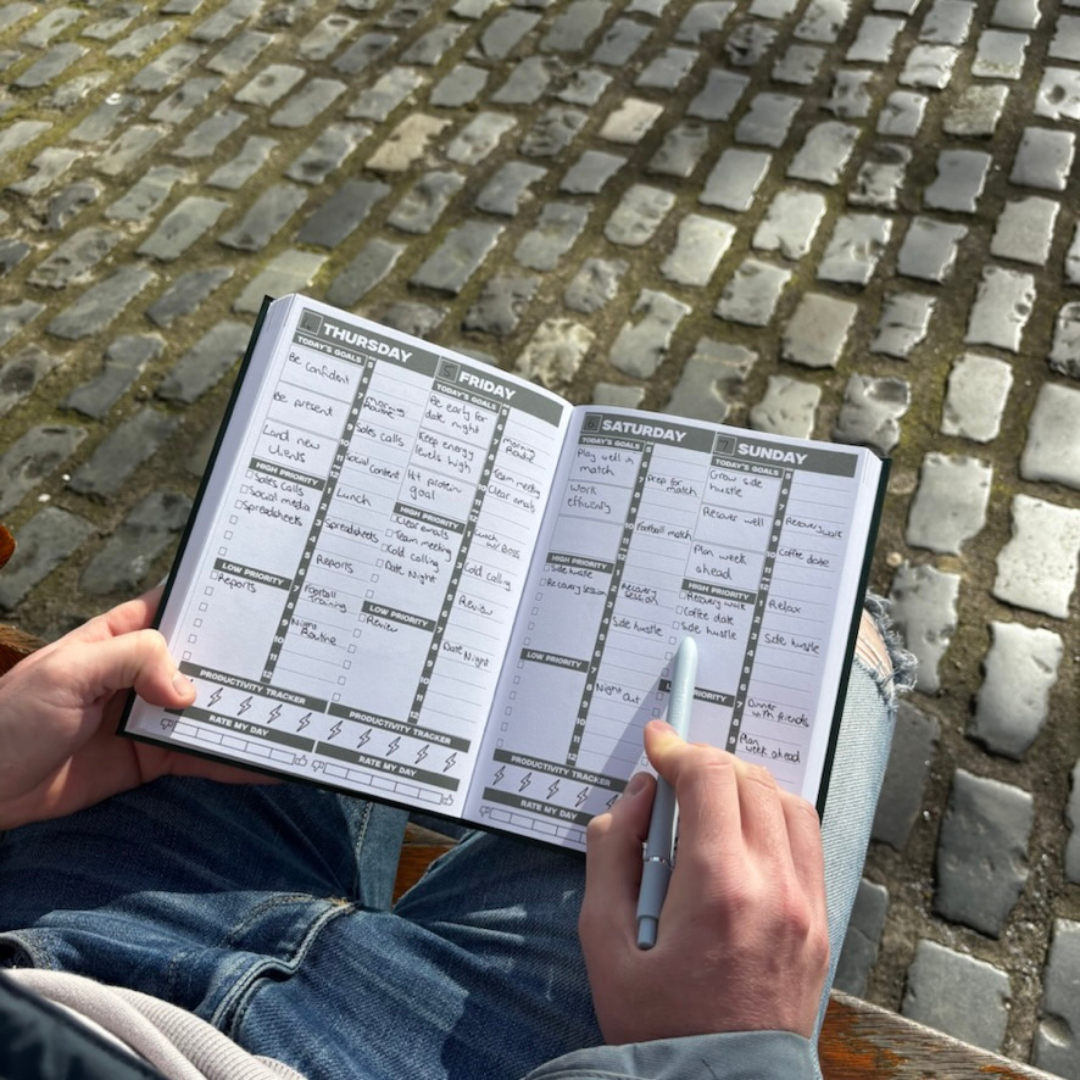
The captured open loops from step two need a real home, not a scattered collection of sticky notes or a mental list that gets re-generated from memory every single evening. Writing them directly into tomorrow's page in the Plan Your Growth undated weekly agenda closes the loop properly, the task has a defined place to be picked up again, which is precisely what allows the brain to actually stop holding onto it overnight. An open loop with nowhere written to land keeps circling. An open loop captured on a specific page, for a specific day, gets released.
Why the Closing Ritual Matters More Than It Seems
Psychologist Tim Pychyl, whose research on procrastination and self-regulation has examined how unfinished tasks affect ongoing attention, has noted that unresolved, unaddressed work-related thoughts tend to intrude more persistently on evening and even sleep quality than tasks that have been deliberately acknowledged and given a clear next step. An evening shutdown routine is not a soft, optional add-on to a productivity system, it is a direct intervention against exactly this kind of intrusive, unresolved mental residue bleeding into hours meant for recovery.
Handling the Days the Routine Gets Skipped
Some evenings genuinely will not accommodate the full shutdown sequence, a late meeting, a family emergency, exhaustion that makes even ten minutes feel like too much. On these nights, a compressed version, just the open-loop capture and tomorrow's first priority, takes under two minutes and still delivers most of the benefit. Skipping the full sequence occasionally is not a failure of the system, it is a normal part of running it across a real, imperfect life, and the compressed version exists precisely for these nights rather than abandoning the practice entirely.
The Bottom Line
An evening shutdown routine gives the workday a genuine ending instead of letting it dissolve unaddressed into the rest of the evening. Run the five-step sequence, review, capture, prioritise tomorrow, close the physical space, and mark it with a consistent closing ritual, at the same time each day. Give the captured open loops a real, specific home rather than letting them circle in memory. The men who actually disconnect in the evening are rarely working less than everyone else, they have simply built a real mechanism for ending the day on purpose.
Capture tomorrow's first priority directly inside the Plan Your Growth undated weekly agenda, and give your evenings back the genuine boundary they have been missing.