The Morning Routine of High-Performing Men: A Real Blueprint
The first hour of your day is not one hour out of sixteen. It is the hour that sets the operating conditions for every hour that follows. A morning routine for men that actually works is not about waking up at 5am or drinking a specific supplement stack. It's about controlling the first sixty to ninety minutes deliberately, before the day's demands start making decisions for you. Most men lose the day before 8am without realizing it, because the first hour got handed over to a phone screen instead of a plan.
Why the First Hour Matters More Than the Others
Decision-making capacity is highest early in the day and depletes with every choice you make afterward, a pattern researchers call decision fatigue. The choices you make in the first hour, what you consume, how you spend it, what you prioritize, are made with your sharpest available judgment of the entire day. Hand that hour to reactive scrolling or unstructured drift and you have spent your best decision-making capacity on nothing, before the day's real demands have even started.
There is also a momentum effect. A first hour that starts with intentional action, a workout completed, a priority task started, a plan reviewed, sets a tone that tends to persist. A first hour that starts reactively, checking messages, responding to whatever is loudest, tends to keep the entire day in that same reactive mode. The morning is not just time. It is a pattern-setting mechanism for everything after it.
The Core Structure
No phone for the first thirty minutes, minimum. This single change produces one of the largest shifts in how a morning feels, because the phone is the fastest route from waking up calm to waking up reactive. The first notification you read hands your attention to whoever sent it. Delay that handoff and the first half hour stays yours.
Movement, even briefly. This does not need to be a full training session if your schedule genuinely does not allow it, though a real workout is ideal when it fits. At minimum, deliberate physical movement, a walk, stretching, a short bodyweight circuit, signals to your system that the day has started with intention rather than inertia. Physical movement early also reliably improves focus for the hours that follow, which compounds the value of protecting that time in the first place.
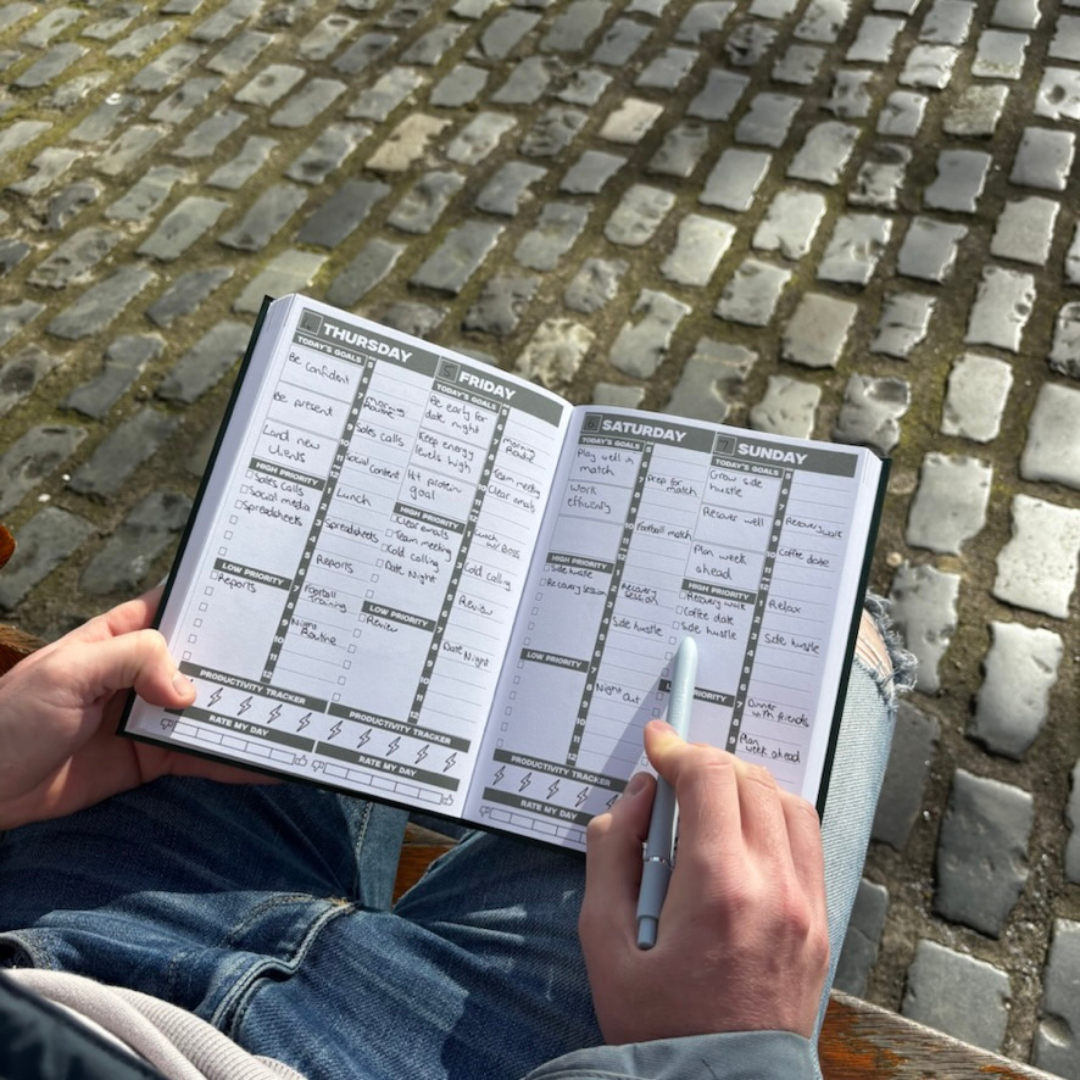
A clear view of the day, decided before it starts. This is where most morning routines fall apart, because they focus entirely on the ritual, the coffee, the cold shower, the journaling, without ever connecting to the actual plan for the day. If you have already blocked your priorities the night before or during a Sunday reset, the morning routine's job is simply to execute the review, not build the plan from scratch under time pressure. The Plan Your Growth undated weekly agenda is built around exactly this handoff: the week gets planned once, and every morning starts with a quick review of a plan that already exists, rather than a fresh negotiation with yourself about what today should look like.
The single highest-leverage task, started before anything else. Once movement and review are done, the first substantial block of the day goes to the one task that matters most, not email, not messages, not the easiest item on the list. This is the hour where your focus is sharpest and your willpower is least depleted. Spending it on your hardest, most important work is the single highest-leverage decision available in the entire day.
Adjusting the Routine to Real Life
A morning routine that requires two hours and a perfectly quiet house is not a routine most men can sustain, especially with families, early meetings, or jobs that do not allow that kind of runway. The core structure above can compress into thirty minutes if needed: five minutes without a phone, ten minutes of movement, five minutes reviewing the day's plan, and starting the priority task within the first half hour of being functional. The specific duration matters less than the sequence: protect attention first, move the body, review the plan, then execute, in that order, every day.
Consistency matters more than duration. A thirty-minute version of this structure, run every single day, will outperform a two-hour version run twice a week and abandoned the rest of the time. Build the routine around what you can actually sustain on your hardest day, not your easiest one, because the hardest day is the one that determines whether the habit survives.
What Derails Most Morning Routines
The most common failure is designing a routine around an idealized version of a morning that does not match your actual life. A single man with a flexible schedule and a father of three with a 7am school run cannot run the same routine, and trying to force one onto the other guarantees failure within two weeks. Build from your actual constraints, not an influencer's schedule.
The second failure is treating the routine as fragile, something that only counts if every element happens perfectly. A morning where the workout gets cut short because of an early call is not a failed morning if the plan review and priority task still happen. Protect the sequence and the intent, not a rigid checklist that falls apart the moment one element shifts.
The third is skipping the plan-review step and assuming the ritual alone, the workout, the cold exposure, the coffee, is sufficient. It isn't. Sleep researcher Matthew Walker's work on the connection between rest, recovery, and next-day cognitive performance underscores a related point: the physical rituals matter, but they support the cognitive work of the day rather than replace it. A perfect physical routine attached to zero clarity about the day's priorities still produces a reactive, scattered day.
Building Your Version This Week
Choose a wake time you can hold on your hardest day, not your best one. Decide the sequence: attention protection, movement, plan review, priority task. Set a realistic duration based on your actual schedule, not an aspirational one. Prepare the night before whatever the morning needs, clothes laid out, the plan already reviewed during a Sunday reset, so the morning itself requires as few decisions as possible. Run it for two weeks before judging whether it's working, because the first few days of any new routine feel harder than the version that eventually becomes automatic.
Building the Routine Around Poor Sleep, Not Ideal Sleep
Most morning routine advice assumes a full night of quality sleep behind it, which is not the reality for a lot of men, particularly those with young children, demanding jobs, or genuine sleep issues. Sleep researcher Matthew Walker's work is clear that no morning ritual fully compensates for chronically insufficient sleep, and pretending otherwise sets up a routine that quietly fails on the exact mornings it's needed most.
The realistic approach on a genuinely poor sleep night is not to force the full routine anyway. It's to protect the highest-value elements, the phone delay and the plan review, since these require the least physical energy, and scale back or skip the movement component if the body genuinely needs the recovery instead. A flexible routine that bends without fully breaking on hard mornings will get run consistently. A rigid one that demands full compliance every day tends to get abandoned entirely the first time a bad night makes it impossible.
The Evening Half of a Good Morning
A strong morning routine is only half controllable in the morning itself. What happens the night before, when you go to bed, what you consume in the hour before, whether tomorrow's plan is already reviewed, sets the conditions the morning routine then executes against. Men who focus entirely on morning optimization while ignoring a chaotic, late, screen-lit evening routine are fighting an uphill battle the routine alone cannot fully solve. A five-minute evening review of tomorrow's plan, paired with a consistent wind-down and bedtime, does more for the following morning's quality than almost any single morning ritual added on top of a disorganized night before it.
The First Week Will Feel Worse Before It Feels Better
Most men expect a new morning routine to feel immediately energizing, and when it instead feels effortful and slightly worse for the first several days, they conclude the routine isn't working and abandon it. This is a predictable, almost universal pattern with any new structure replacing an old default, and it has nothing to do with whether the routine itself is well designed. Give it a minimum of two full weeks before making any real judgment. The discomfort of the first few days is the cost of breaking an old default pattern, not a signal that the new one is wrong.
Traveling Without Losing the Routine
Travel is where most morning routines quietly die, and it doesn't need to be. The core sequence, protect attention, move the body, review the plan, start the priority task, doesn't require your home gym or your usual coffee setup. It requires roughly thirty minutes and a willingness to run a stripped-down version rather than skipping it entirely because the full version isn't available. A hotel room floor is enough space for movement. A notebook works in an airport lounge as well as it does at your desk. The men who maintain momentum through a busy travel month are rarely running a more elaborate routine than everyone else. They're running the same simple sequence, just refusing to let an unfamiliar environment be the excuse to drop it.
What to Do on the Mornings It Falls Apart Anyway
Even a well-designed, flexible routine will occasionally collapse entirely: a sick child, a broken alarm, a genuine crisis that starts before you're even out of bed. The mistake on these mornings is trying to cram a compressed version of the full routine into whatever few minutes remain, which usually just produces a rushed, unsatisfying version of all four elements instead of a solid version of one. On a genuinely lost morning, pick the single highest-value element, usually the plan review, since it takes the least time and delivers the most clarity for the day ahead, and let the rest go entirely without guilt. One good element beats four rushed ones, and a morning handled this way still gives you a functioning plan for the day even when nothing else about it went as intended.
The Bottom Line
A high-performing morning routine is not about waking up earlier than everyone else. It is about protecting the first hour's attention, moving your body deliberately, reviewing a plan that already exists, and starting your hardest work while your focus is at its sharpest. Build a version you can sustain on your worst day, not your best, and hold the sequence even when the exact timing has to flex around real life.
The Plan Your Growth undated weekly agenda takes the guesswork out of the plan-review step: your priorities for the day are already decided from your weekly planning, so your morning routine's only job is to execute, not decide. No printed dates, so the routine you build this week starts today, not on the next symbolic Monday.