The Reading System: How High Performers Build Real Knowledge
Reading fifty books a year means nothing if you cannot recall a single specific idea from most of them three months later. That is the uncomfortable truth behind the reading challenge culture that treats book count as the metric that matters. A real reading system is not built around volume, it is built around retention and application, and it looks almost nothing like the speed-reading, book-a-week content that gets the most attention online.
Why Book Count Is the Wrong Metric
The instinct to track total books read comes from the same place as tracking hours worked instead of output produced: it is easy to measure and it feels productive, even when it correlates poorly with the thing you actually care about. Reading quickly through a large volume of books produces a satisfying number to post online, but it says nothing about whether any of that content changed how you think or act.
Cognitive scientist Jeffrey Karpicke's research on retrieval practice, published through Purdue University and available at psych.purdue.edu, demonstrates that passive re-reading and consumption, the mode most speed readers are actually in, produces dramatically worse long-term retention than active retrieval, the deliberate effort to recall and reconstruct information from memory rather than simply re-exposing yourself to it. This is the core problem with volume-focused reading: it optimises for exposure, not for the retrieval practice that actually builds durable knowledge.
The practical implication is straightforward. A man who reads twelve books a year with a real retention system will end the year with more usable, applicable knowledge than a man who reads fifty books with no system at all. The count is not the achievement. The retained, applied knowledge is the achievement, and it requires a completely different process to build.
Building the Reading System: Capture, Retrieve, Apply
A working reading system has three stages, and skipping any one of them is why most reading produces so little lasting value. The first stage is capture: while reading, actively note the specific ideas that feel genuinely useful or challenge something you currently believe, rather than passively consuming the entire text and hoping the important parts stick on their own.
This does not require an elaborate note-taking system. A simple method: after each chapter, write two or three sentences in your own words summarising the single most useful idea, not a full chapter recap. Forcing yourself to compress the chapter into your own words is itself a form of retrieval practice, and it is far more valuable than highlighting passages you will likely never revisit.
The second stage is retrieval: at fixed intervals, a week after finishing the book, then a month later, then three months later, pull out your captured notes and try to recall the core ideas before rereading them. This spaced retrieval is what transforms information from something you briefly understood into something you can actually access under pressure, in a meeting, in a decision, months after you closed the book.
The third stage is application: for every book that produces a genuinely useful idea, identify one specific, concrete action you will take because of it within the next week. A book that changes zero of your actual behaviour was, functionally, not worth reading regardless of how many insights it seemed to contain while you were reading it.
Where the Reading System Lives in Your Week
None of this works without a fixed place to run it, which is exactly where most reading systems fail. Good intentions to "review my notes sometime" rarely survive contact with a busy week, because there is no specific time blocked for it and no specific trigger reminding you it is due.
Build two fixed touchpoints into your weekly planning system. First, a short capture window, ten to fifteen minutes at a consistent point in the week, for compressing whatever you read that week into your own words. Second, a review window, on the same day each week, for pulling up notes from books at the one-week, one-month, and three-month intervals and actively recalling them before checking against what you wrote.
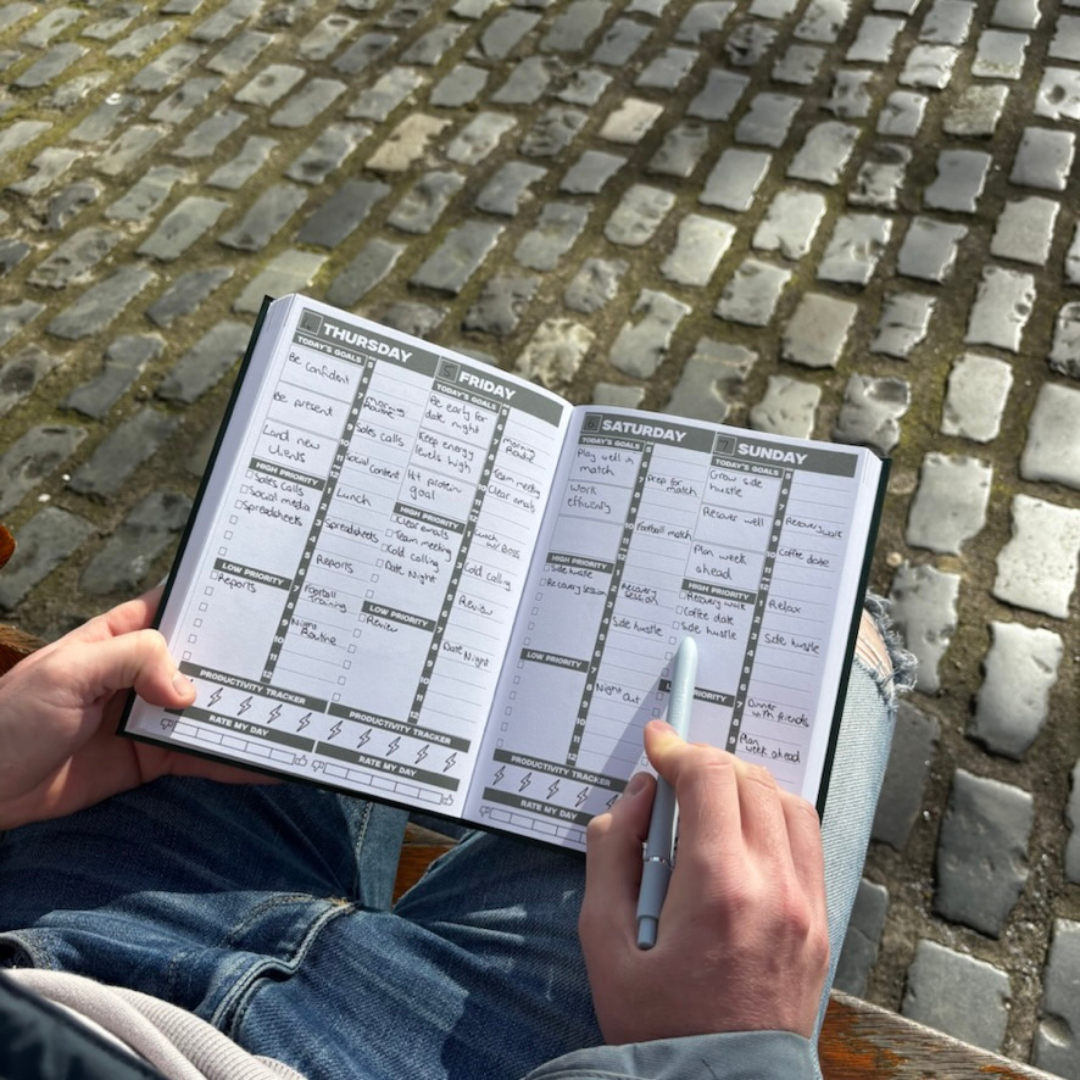
The <a href="/products/plan-your-growth-undated-weekly-agenda">Plan Your Growth undated weekly agenda</a> works well for this because it holds your reading review alongside your other weekly priorities, which keeps the system from being the first thing dropped when the week gets busy. A reading system that only exists in your head competes poorly against deadlines with external enforcement. A reading system with fixed, scheduled touchpoints in your actual weekly plan competes on equal footing.
What to Actually Read for Compounding Returns
Not all reading deserves the full capture-retrieve-apply cycle. Fiction read purely for enjoyment, or light reading with no intended application, does not need this treatment, and forcing a heavy system onto every single book you touch will make you resent reading altogether. Reserve the full system for books directly relevant to a goal you are actively working toward, whether that is a specific skill, a business problem, or a domain you are deliberately building expertise in.
Within that category, prioritise depth over breadth on any single topic before moving broadly across many unrelated subjects. Reading three serious books on negotiation will build more usable skill than reading one book each on ten unrelated topics, because the second and third books on the same subject let you cross-reference and reinforce the same underlying concepts from different angles, which is itself a powerful form of retrieval and consolidation.
This is a deliberate trade-off against the impulse to constantly chase novelty in what you read next. Depth compounds. Breadth for its own sake mostly just accumulates.
A practical way to apply this is to pick two or three domains directly relevant to your current goals at the start of each year, and deliberately weight most of your serious, full-system reading toward those domains for the following several months. This does not mean refusing to pick up anything outside those areas, it means being honest that a book outside your chosen focus is likely to get the lighter, capture-only treatment rather than the full retrieval and application cycle, and that is a reasonable trade-off given limited time.
Choosing Between Books, Audio, and Summaries
Part of building a sustainable reading system is being honest about which format you will actually use consistently, rather than assuming physical books are the only legitimate option. Audiobooks work well for the capture stage during commutes or workouts, but they make the note-taking step harder in the moment, which means you need a fallback, a voice memo, a quick note dictated immediately after finishing a chapter, to avoid losing the idea before you can properly capture it later.
Book summary services and condensed versions have a narrower but real place in this system. They work well for triaging, quickly assessing whether a book merits the full capture-retrieve-apply treatment, before committing the time to read it properly. They work poorly as a replacement for that full treatment on a book that genuinely matters to a goal you are working toward, because a ten-minute summary cannot replicate the depth of engagement that produces real retention and application.
The honest answer is that format matters less than consistency. A capture and review system you actually run every week on audiobooks will outperform an elaborate physical annotation system for print books that you abandon after three weeks because it demanded more friction than your actual schedule could sustain.
Tracking Progress Without Falling Back Into Book Count
The temptation to revert back to counting books is strong because it is simple and visible. A better metric to track is the number of ideas you have successfully applied, the specific actions taken because of something you read, logged in the same place as your reading notes. This number will be smaller than your book count, and it will actually mean something.
Review this applied-ideas log at the same cadence as your broader goal audits, quarterly works well. Ask honestly which books produced real, lasting change in how you think or act, and which ones, in retrospect, were mostly entertainment dressed up as self-improvement. This honest audit refines your reading choices over time, steering you toward the kinds of books and authors that reliably produce applicable value for you specifically, rather than whatever is trending in a given month.
Over several quarterly reviews, a clear pattern usually emerges. Certain authors, genres, or specific types of books will consistently show up in your applied-ideas log, while others, despite feeling insightful in the moment of reading, will rarely produce anything you actually acted on. Let this pattern guide your future reading choices more heavily than recommendations from other people, since it reflects what genuinely works for how you specifically think and operate, not a generic assessment of which books are considered good.
Discussing What You Read as Part of the System
One of the most underrated forms of retrieval practice is simply explaining an idea to another person, out loud, without notes. This forces a more demanding form of recall than reviewing your own written summary, because you have to reconstruct the idea clearly enough for someone else to follow it, which exposes any gaps in your actual understanding far faster than silently rereading a note ever would.
Build this into your reading system deliberately rather than hoping it happens naturally. This could mean a standing conversation with a colleague or friend about what you are each reading, a short explanation you give at the start of a team meeting about a relevant idea from a current book, or simply a habit of bringing up one specific idea from your recent reading in ordinary conversation instead of defaulting to small talk. Each of these moments functions as an additional retrieval checkpoint beyond the ones already scheduled in your weekly review.
Men who build this social layer into their reading system report that it does double duty: it strengthens their own retention through the added retrieval practice, and it often surfaces genuinely useful pushback or a different angle on the idea from the person they are explaining it to, refining the idea further before they attempt to apply it.
The Bottom Line
A real reading system is built on capture, spaced retrieval, and application, not on the number of books finished in a year. Compress each chapter into your own words as you read, schedule fixed review points at one week, one month, and three months to actively recall the core ideas, and commit to one concrete action per book that produced something genuinely useful. Track applied ideas, not book count, and let that honest metric guide what you choose to read next.
The Plan Your Growth undated weekly agenda is where your capture and review windows live, scheduled alongside the rest of your week so the system runs on structure instead of the good intentions that rarely survive a genuinely busy month.