The Sunday Planning Ritual That Puts You Ahead by Monday
Most men start their work week the same way: Monday morning, coffee in hand, opening email cold and reacting to whatever landed overnight. This is not a planning failure exactly, it is the absence of any planning at all, and the cost compounds every single week. A structured Sunday planning ritual, thirty minutes, is the difference between walking into Monday already knowing exactly what the week demands and walking in blind, letting the first loud email set the entire tone for the next five days.
Why Sunday Specifically, Not Just "Sometime This Weekend"
A common mistake is treating weekend planning as a loose intention rather than a fixed appointment tied to a specific day and time. "I'll plan the week at some point this weekend" almost always loses to whatever else the weekend offers, and by Sunday night the planning either happens rushed and half-hearted or gets skipped entirely. Fixing the ritual to a specific day and time, not a vague weekend window, removes the ongoing negotiation about when it will happen and replaces it with a standing commitment the same way a recurring meeting would function on any other day of the week.
The Cost of an Unplanned Monday
Without a Sunday planning ritual, Monday's first hour gets spent doing the planning that should have happened the day before, except now it happens under pressure, with the inbox already filling and meetings already starting. This produces a worse plan, built reactively rather than deliberately, and it burns the highest-energy hour of the week, the hour right after the weekend reset, on administrative overhead instead of actual execution.
Men who run a consistent Sunday planning ritual report walking into Monday already knowing the week's three priorities, already having their calendar blocked, already ahead of colleagues who are still figuring out their week in real time. This is not a minor edge. Compounded weekly, it is the difference between a career built on deliberate execution and one built on constant reaction.
Reviewing the Weekend Itself Before Planning Forward
A brief, honest look at how the weekend was actually spent, before jumping into next week's plan, catches patterns worth knowing about. A weekend that consistently gets consumed by low-value screen time rather than genuine recovery tends to produce a Monday that starts already depleted rather than refreshed. This is not about scheduling every weekend hour, it is a two-minute honest check: did the weekend actually restore energy, or did it just pass, because that answer affects how the coming week should be paced and where extra recovery might need to be deliberately built in.
The Structure of an Effective Sunday Session
A Sunday planning ritual that survives long-term needs a fixed structure, not a vague intention to "think about the week." Thirty minutes, broken into four specific parts, done at the same time every Sunday so it becomes a fixed appointment rather than a floating maybe.
Review the last week, five minutes. What got done against what was planned, what specifically caused any gap. This is not optional self-flagellation, it is the raw data the coming week's plan should be built on.
Identify the week's three priorities, five minutes. Not ten tasks, three. The single highest-leverage outcomes that would make the week a genuine success if nothing else got done. Everything else is secondary and gets built around these three.
Block the calendar, fifteen minutes. Every fixed commitment first, meetings, calls, then the three priorities scheduled into the highest-energy windows available, then remaining tasks filling what is left. This is where the week moves from a list of intentions to an actual executable schedule.
Set up Monday specifically, five minutes. What is the very first task Monday morning, locked in before the inbox opens. This single step alone eliminates the most common failure point, the first hour of the week getting hijacked by reactive email instead of starting with the highest-priority task already decided in advance.
Pairing the Ritual With a Consistent Environment
The Sunday planning ritual benefits from the same environment discipline that supports deep work: a consistent location, minimal distraction, phone set aside for the duration of the session. A ritual conducted while half-watching television or responding to messages between steps produces a noticeably weaker plan than one conducted with full attention for thirty focused minutes. The environment does not need to be elaborate, a specific chair, a coffee, thirty minutes of genuine quiet, is enough to signal a clear shift into planning mode rather than treating it as background activity squeezed in alongside something else.
Where the Ritual Lives
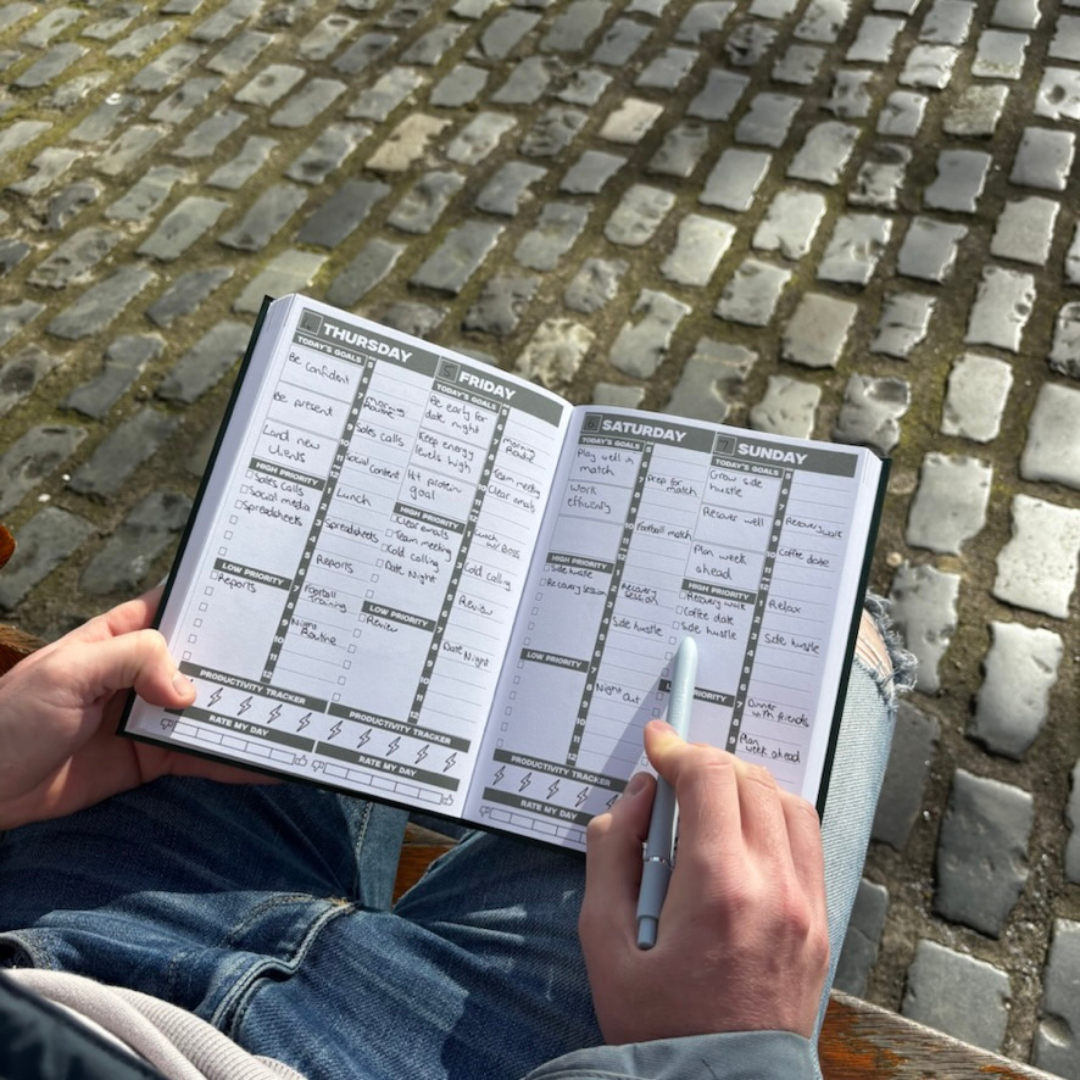
A Sunday planning ritual needs a fixed physical home to avoid becoming another vague good intention. The Plan Your Growth undated weekly agenda is built with a weekly overview page specifically for this kind of session, giving the three priorities and the calendar block-out a dedicated space rather than scattering the plan across a notes app, a calendar, and memory.
Doing this in the same physical planner every week, rather than a different app or a blank page, builds the ritual through consistency of location as much as consistency of timing. The brain associates the specific physical action, opening this particular planner on Sunday, with the shift into planning mode, which makes the ritual easier to sustain than one that requires deciding fresh each week where the planning will even happen.
Adapting the Ritual for a Non-Traditional Schedule
Not every man works a standard Monday-to-Friday week, and a Sunday planning ritual should be anchored to whatever day genuinely precedes your work week, not rigidly forced onto a calendar Sunday if your schedule runs differently. Shift workers, freelancers, and men with rotating schedules should identify their actual "day before the work week starts" and anchor the ritual there instead. The specific day matters far less than the underlying mechanism: a fixed, protected planning session immediately before the working stretch begins, wherever that falls on your particular calendar.
Protecting the Ritual From Getting Skipped
The single biggest threat to a Sunday planning ritual is a busy Sunday itself, family commitments, a late weekend, the temptation to skip it "just this once" and plan on the fly Monday morning instead. Treat the thirty minutes as fixed, not flexible, the same non-negotiable status as any other commitment that matters. If Sunday genuinely does not work some week, move it, do not skip it, even a compressed fifteen-minute version Sunday night beats walking into Monday with nothing planned at all.
What Changes Over Consistent Weeks
The compounding advantage of a Sunday planning ritual is not obvious in any single week. It becomes obvious after two or three months of consistency: fewer Monday mornings lost to reactive scrambling, a clearer sense of whether the week's real priorities are actually getting attention, and a growing trust in your own ability to plan and execute rather than just react and survive. This trust is not abstract. It is built the same way any skill gets built, through repeated, deliberate practice, week after week.
The Bottom Line
A Sunday planning ritual is thirty minutes that put you a full day ahead of every man still improvising his week on Monday morning. Review the last week honestly, name three real priorities, block the calendar around them, and lock in Monday's first task before the inbox has a chance to hijack it. Protect the ritual the same way you protect any commitment that actually matters, because over months, this single habit compounds into a genuinely different relationship with your own time.
Build your Sunday session into the Plan Your Growth undated weekly agenda, where the weekly structure is already built to hold exactly this kind of deliberate planning.