The Sunday Reset Routine Every Ambitious Man Needs
Monday's chaos is decided on Sunday, not Monday. Ask any man what's holding him back from a productive week and he'll usually blame Monday morning: the inbox, the meetings, the fires. The real cause is almost always what happened, or didn't happen, the evening before. A Sunday reset routine is not a self-care ritual. It is a structural decision that determines whether you walk into Monday with a plan or without one, and those two Mondays are not the same week.
Why Sunday Specifically
Sunday works because it sits at the exact hinge point between one week ending and the next beginning, with enough distance from Friday's exhaustion to think clearly and enough runway before Monday to actually act on what you decide. Planning on Sunday night means Monday morning starts with execution instead of orientation. You already know what the week holds. You are not discovering it in real time while also trying to do the work.
Compare that to the far more common pattern: no reset at all, and Monday becomes the day you catch up on everything that should have been decided already. By the time you have sorted through your inbox and reconstructed what actually needs to happen this week, you have burned your highest-energy hours on administration instead of execution.
The Four Parts of an Effective Reset
Clear the physical and digital clutter. Before you can plan clearly, close the loops from last week. Empty the inbox to zero, or at least to a manageable holding pattern. Clear your desk. This is not about tidiness for its own sake. An environment full of unresolved loose ends keeps low-level cognitive load running in the background, and that background noise is exactly what makes Sunday planning feel harder than it needs to be.
Review the week that just ended, honestly. What actually got done versus what you planned to get done. Where did the week go sideways, and why. This step gets skipped constantly because it can feel uncomfortable to look directly at a week that didn't go as planned. Skip it anyway and you lose the single most useful input for planning the week ahead: the pattern of what actually happens versus what you intend, which is the gap every planning system exists to close.
Set the one to three priorities for the coming week. Not a full task list yet, just the handful of things that would make the week a genuine win if nothing else got done. This step forces a decision most men avoid: ranking. Everything feels important in the abstract. Ranking forces you to admit that some things matter more than others, and that admission is what protects your best hours from getting eaten by whatever is loudest on Monday morning.
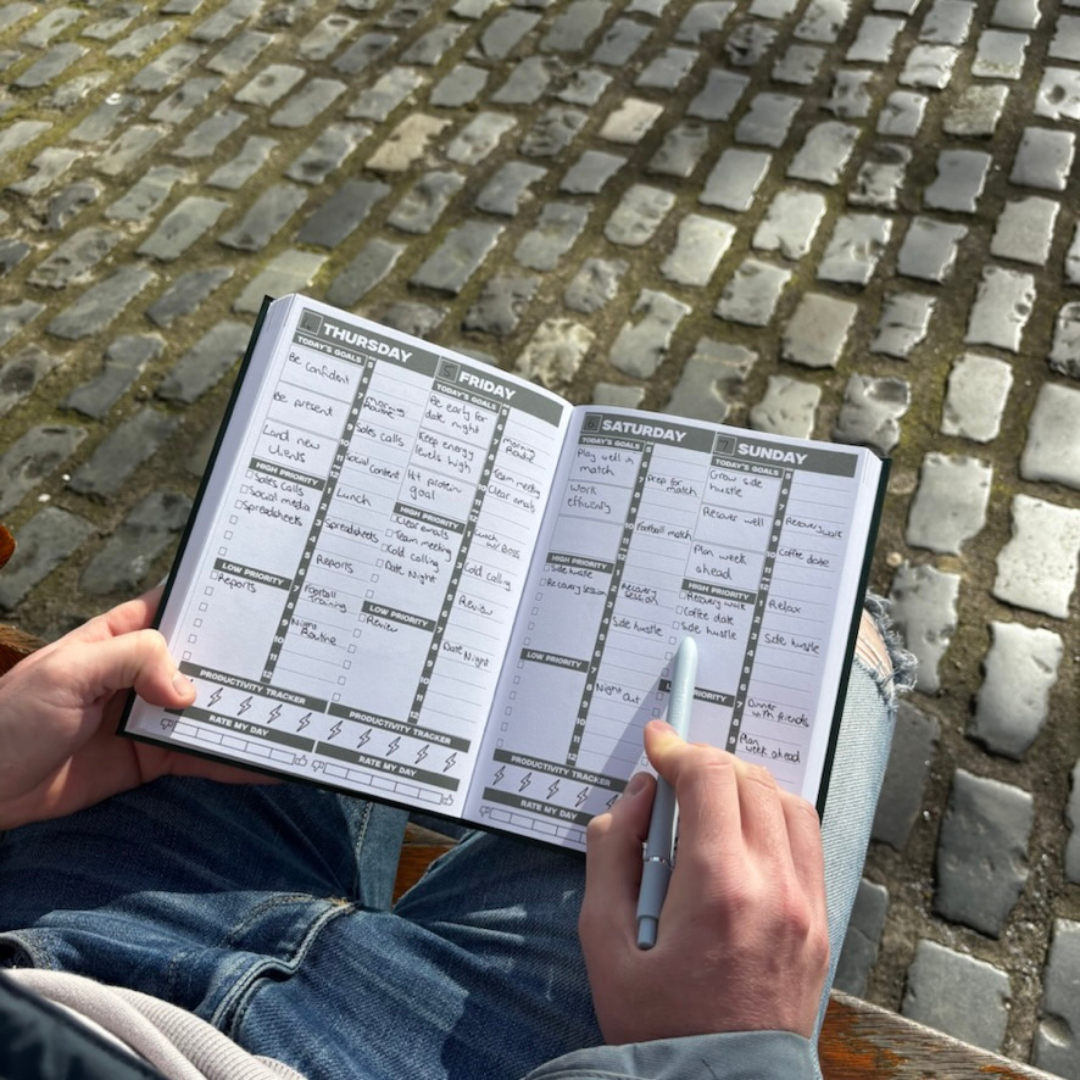
Block the week at a high level. Not a minute-by-minute schedule yet, just the shape of the week: which days have the space for deep work, which are consumed by fixed commitments, where the priorities from step three actually fit. This is the step that turns a list of intentions into an actual plan with time attached, and it is exactly what the weekly layout inside the Plan Your Growth undated weekly agenda is built for: one page to see the whole week and place your priorities into it before Monday, not during it.
What to Physically Do During the Reset
Sit down, ideally away from a screen, with a single planner or notebook. The physical act matters more than it seems. A digital planning session competes with every notification on the device you are planning on. A paper session does not. There is also a documented effect where writing something down by hand creates stronger encoding and follow-through than typing the same thing, which is part of why an undated weekly agenda, not a digital calendar app, tends to produce a more honest and more followed-through weekly plan.
Give the whole process forty-five minutes to an hour. Less than that and you are rushing the honest review step. More than that and you risk turning planning into procrastination, where the act of planning becomes a way to avoid starting the actual work.
Do it at the same time every Sunday. Consistency of timing matters as much as the content. A reset that happens "sometime on Sunday, whenever there's a gap" is a reset that will eventually get skipped the first busy weekend it collides with. A reset scheduled for 6pm every Sunday, treated the way you would treat a standing meeting, survives the busy weeks precisely because it doesn't require a fresh decision every time.
Common Mistakes That Undermine the Reset
The most common failure is skipping the honest review step and jumping straight to planning the next week. Without reviewing what actually happened, you repeat the same overestimation errors week after week, planning a week's worth of tasks into the same amount of time that consistently proves insufficient.
The second is over-planning every hour of the week during the reset, which leaves zero room for the inevitable disruption, and the first blown assumption cascades into abandoning the whole plan by Tuesday. Leave slack deliberately. A realistic plan with breathing room survives contact with reality. A perfect plan with none does not.
The third mistake is treating the reset as optional the moment life gets busy, which is precisely backwards. The busier the week ahead looks, the more valuable a clear-headed Sunday plan becomes, because a busy week without a plan is where things actually fall apart. Behavioral research on procrastination, including the work of Carleton University psychologist Tim Pychyl, points to a consistent pattern: the tasks we avoid planning for are usually the ones we most need a plan for, because avoidance itself is often driven by the discomfort of facing an unclear or overwhelming workload head-on.
A Simple Template to Start This Sunday
Fifteen minutes: clear the inbox and the desk. Ten minutes: review last week honestly, what got done, what didn't, and why. Ten minutes: choose your one to three priorities for the coming week. Fifteen minutes: block the shape of the week at a high level, placing those priorities into specific days. Five minutes: lay out anything physical you need for Monday morning, so the first decision of the week is already made before you wake up.
Adjusting the Reset for a Family Household
Men with families often assume a quiet, uninterrupted Sunday reset is unrealistic, and depending on the household, it might be. The fix is not abandoning the practice but shrinking and relocating it. Twenty minutes early Sunday morning, before the household is fully awake, or a slot after kids are down for the night, often works better than trying to find an hour of true silence that may not exist on a family Sunday.
The four core steps still apply, they simply need to be run at a faster pace: five minutes clearing the inbox, five minutes on an honest review, five minutes setting the top three priorities, five minutes blocking the week's shape. A compressed twenty-minute version run every single week will produce more value than an idealized sixty-minute version that only happens when the house is unusually quiet, which for a lot of families is rarely.
What to Do When Sunday Genuinely Isn't Available
Travel, family emergencies, and irregular schedules will occasionally make Sunday impossible. The fix is a backup slot, decided in advance, not improvised after the fact. Pick a second day, commonly Friday afternoon or Monday early morning, that serves as your fallback whenever Sunday isn't available, and treat it with the same seriousness as the primary slot.
What matters is that the reset happens somewhere in the week's boundary, not that it happens on a specific calendar day. A reset run on Monday morning instead of Sunday evening still delivers most of the value, provided it happens before the bulk of the week's work has started, rather than being abandoned entirely because the ideal day didn't work out.
What Changes After a Few Months of Consistency
The first several weeks of running a Sunday reset tend to feel mechanical, a checklist executed more out of discipline than genuine insight. That changes with repetition. By the second or third month, the honest review step starts surfacing real patterns you would not have noticed week to week: the specific type of task you consistently underestimate, the day of the week your energy reliably drops, the category of commitment you keep overcommitting to. This is the actual long-term value of the ritual, not just a smoother Monday, but a genuinely more accurate self-model built from months of honest weekly data that a single reflective moment could never produce on its own.
Pairing the Reset With a Physical Trigger
A reliable way to anchor a new Sunday habit is attaching it to something you already do consistently, rather than relying on memory alone. If you already make coffee at a set time on Sunday evenings, do the reset immediately after. If you have a standing family dinner, do it right after the table is cleared. This kind of habit stacking, borrowed from broader habit-formation research, removes the need to remember the new behavior on its own and instead lets an existing routine trigger it automatically, which is a large part of why the habit survives past the first few motivated weeks.
A Note on Perfectionism
Some men avoid starting a Sunday reset because they want the first attempt to be polished, a fully worked-out system before they commit to it. This backwards approach delays the actual value indefinitely. The honest version of this habit is built through repetition and adjustment, not designed perfectly in advance. Run a rough, imperfect version this Sunday. Notice what felt clunky. Adjust next week. By the fourth or fifth attempt, the routine will look nothing like the first one and will fit your actual life far better than anything you could have planned from a blank page before ever trying it once.
The Bottom Line
A Sunday reset routine works because it moves the hardest cognitive work, deciding what the week is actually about, out of Monday morning and into a calm, dedicated hour the evening before. Clear the clutter, review the previous week honestly, set your top priorities, and block the shape of the week before you close the notebook. Do it at the same time every Sunday, on paper, and give it forty-five minutes minimum.
The Plan Your Growth undated weekly agenda was built around exactly this ritual: a weekly layout that gives you a single page to review, prioritize, and block the coming week, with no printed dates forcing you to wait for a symbolic Sunday to start. Pick it up and your reset routine starts this week, not next month.