The Sunday Reset: The 30-Minute Ritual That Sets Up Your Week
Monday morning does not have to feel like a scramble, and if it consistently does, the problem is not Monday. It is Sunday, or more specifically, the thirty minutes of planning you skipped on Sunday because you told yourself you would figure it out as the week went along. You will not figure it out as the week goes along. You will react your way through it, the same way you did last week and the week before that. The Sunday reset fixes this with a fixed, repeatable ritual that turns the entire following week from improvisation into execution.
Why Sunday Is the Highest-Leverage 30 Minutes of Your Week
Every other planning window competes with active demands. Plan on Monday morning and you are already fighting the first email, the first meeting, the first fire that needs putting out. Plan mid-week and you are reacting to whatever the first half of the week already threw at you. Sunday is different. Sunday sits in a quiet gap between weeks, with enough distance from last week's noise to review it objectively, and enough proximity to next week's start to make the plan immediately actionable.
This is not an arbitrary preference. Research on planning behavior consistently shows that intentions formed with specific implementation details, not vague hopes, are dramatically more likely to be executed. A Sunday reset is exactly that: converting vague intentions about "having a productive week" into a specific, written plan with named tasks in named time slots. The gap between intention and specificity is where most weeks quietly fail before they even begin.
Skip the Sunday reset and Monday becomes the default planning session, except now you are planning under pressure, with your first meeting already looming and your inbox already filling. Decisions made under pressure are worse decisions. The Sunday reset moves your planning into a calm window specifically so your Monday decisions are already made.
The Four-Part Structure
A Sunday reset does not need an hour. It needs thirty minutes, run in the same order every time, so the ritual becomes automatic rather than something you have to reinvent weekly.
Part one: review the week behind you (8 minutes). Look at what you planned last Sunday against what actually happened. What got done. What did not. What ran long. This is not a guilt exercise. It is data collection. You cannot build an accurate plan for next week without an honest read on how last week actually went, including where your time estimates were wrong and where distractions repeatedly pulled you off course.
Part two: clear the mental backlog (7 minutes). Dump every open loop currently occupying mental space, every task, reminder, and half-formed obligation floating around in your head. Psychologist Roy Baumeister's research on unfinished tasks, often referred to as the Zeigarnik effect, found that incomplete tasks occupy cognitive space and create low-grade background stress until they are either completed or explicitly captured somewhere outside your head. Writing them down is not just organization. It is a direct reduction in mental noise.
Part three: set the week's non-negotiables (10 minutes). Identify three to five tasks that, if completed, would make this a genuinely successful week regardless of what else happens. Not the loudest tasks. The ones with the highest leverage toward what actually matters to you. Assign each a specific day and, ideally, a specific time block. A non-negotiable without a scheduled slot is just a hope wearing a more serious name.
Part four: preview the calendar (5 minutes). Look at every fixed commitment already on your calendar for the week ahead: meetings, appointments, obligations. Many men build their ideal week and then discover Thursday is already consumed by four recurring meetings they forgot about. Better to know that Sunday evening than to discover it Thursday morning when your plan collapses in real time.
Making the Sunday Reset Stick
The single biggest reason men abandon the Sunday reset is inconsistency in timing. If it happens whenever you get around to it, it competes with every other Sunday activity and usually loses. Fix a specific time, ideally the same window every week, evening works well for most men since it caps off the weekend with intention rather than dread. Treat it as a fixed appointment with yourself, non-negotiable the same way a meeting with your boss would be non-negotiable.
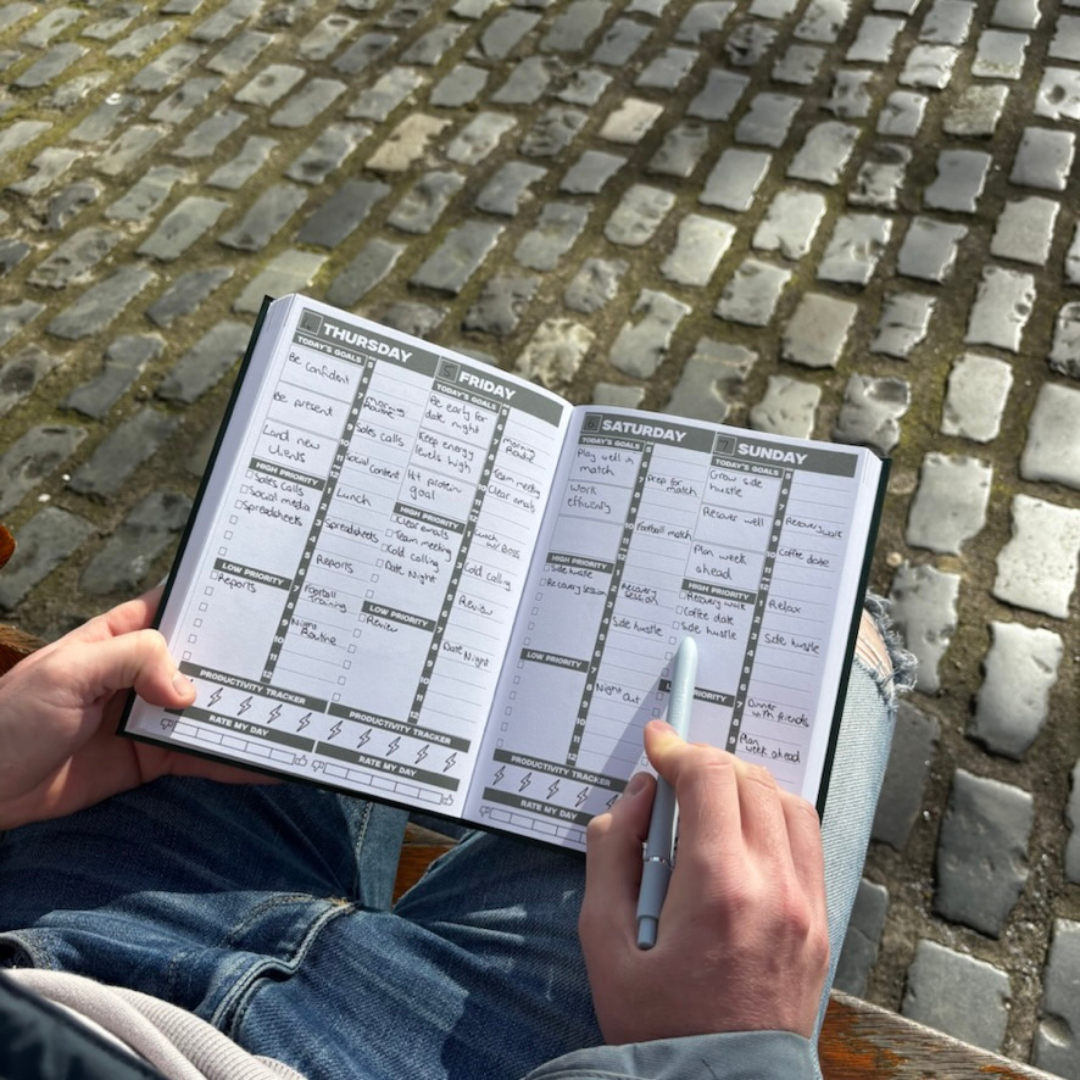
The second biggest reason is doing it entirely in your head. A mental plan degrades within hours, buried under new inputs the moment Monday's first email lands. A written plan survives, specifically because it does not depend on memory. The Plan Your Growth undated weekly agenda is built around exactly this weekly structure: one page that holds your priorities, your habit tracking, and your daily blocks, so the Sunday reset produces a physical artifact you actually reference all week instead of a plan that quietly evaporates by Tuesday.
What Changes After 90 Days of Sunday Resets
One Sunday reset changes almost nothing you would notice. Twelve of them in a row change the entire texture of how your weeks feel. The first two or three weeks feel like extra effort tacked onto an already busy Sunday. Around week four, most men report the ritual starting to feel less like a task and more like relief, a way to close out the weekend with a clear head instead of a vague Sunday-night anxiety about everything Monday might bring.
By week eight, the pattern compounds. Weeks that start with a clear plan produce fewer emergencies, because more of what would have become urgent got caught and scheduled proactively instead. This is the actual mechanism behind why consistent planners report less stress, not because their lives contain fewer demands, but because fewer of those demands arrive as surprises. A previewed calendar cannot ambush you the way an unreviewed one can.
Common Sunday Reset Mistakes
Making it too long. If your Sunday reset takes ninety minutes, you will start skipping it the first busy weekend that comes along. Keep it to thirty minutes. The goal is a repeatable habit, not a perfect planning session.
Reviewing without setting non-negotiables. Looking back at last week without deciding what matters most for next week leaves you with insight but no plan. Both halves matter. The lookback without the lookforward is just journaling.
Treating it as optional on busy weekends. The weeks you are most tempted to skip the Sunday reset, because the weekend was chaotic or you are exhausted, are exactly the weeks you need it most. A rushed ten-minute version beats skipping it entirely.
The Bottom Line
Monday chaos is manufactured on Sunday, not Monday. Thirty minutes of structured review, backlog clearing, priority setting, and calendar preview is the difference between walking into your week with a plan and walking into it hoping things work out. Run the same four-part structure every Sunday at the same time until it stops feeling like effort and starts feeling like the natural close to your weekend. The week that follows will look different, not because you worked harder, but because you decided what mattered before the noise had a chance to decide for you.
The Plan Your Growth undated weekly agenda is designed to hold your entire Sunday reset in one page, priorities, habits, and daily blocks together, so the plan you build Sunday evening is the same plan you are still using by Friday. Build the ritual once. Let the structure carry you through the weeks that follow.