The Time Blocking Method: How to Actually Own Your Calendar
Your day isn't crowded. Your attention is. The average knowledge worker switches tasks every 47 seconds and loses roughly 23 minutes to fully refocus after each interruption. Time blocking is not a productivity optimisation. It is the structural recovery of hours you already lost. Most men run their day off a to-do list, which sounds organised but functions as pure chaos: no order, no time estimates, no defence against whoever emails you first winning your morning. The time blocking method fixes this by giving every hour a job before the day starts, not after it has already gotten away from you.
The Real Cost of an Unblocked Hour
An unblocked hour is not neutral time waiting to be used efficiently. In practice it defaults to whatever demands the least effort to start: checking email, scrolling a notification, answering the first message that arrives. This is not a character flaw, it is the predictable behaviour of attention with no assigned direction. An hour with no block competes against every low-effort distraction available, and low-effort distraction wins by default almost every time, not because the work mattered less but because it required more activation energy to start than checking a phone did. Time blocking removes this default by pre-deciding, before the moment of temptation arrives, exactly what this hour is for.
Why a To-Do List Alone Doesn't Work
A to-do list tells you what needs doing. It says nothing about when, for how long, or in what order, which means the day defaults to reactive execution: whatever feels most urgent in the moment, whoever messaged last, whatever fire is loudest. This produces motion without direction. You end most days exhausted and behind on the thing that actually mattered, because the list gave every task equal weight and your attention went to whichever one shouted the loudest.
The time blocking method solves this by assigning every task a specific slot on the calendar before the day begins. A task with no time slot is not a plan, it is a hope. Once something has a block, it competes for that block, not for your attention throughout the entire day.
The Core Mechanism
Time blocking works on a simple principle: your calendar, not your to-do list, is the single source of truth for the day. Every task that matters gets a specific start time and duration. Meetings, deep work, admin, even breaks get blocked, because unblocked time defaults to whatever demands attention loudest, usually email or Slack.
Cal Newport, the computer scientist behind the concept of deep work, has argued extensively that the ability to focus without distraction is becoming both increasingly rare and increasingly valuable precisely because most professional environments are structured to prevent it by default. Time blocking is the mechanism that reclaims that focus deliberately, by assigning specific windows where deep work is the only thing allowed to happen, rather than hoping it emerges from whatever time is left over after meetings and interruptions.
Building Your First Time-Blocked Day
Start the night before, not the morning of. Decision-making bandwidth is highest with distance from the day itself, and a plan built in the calm of the evening survives contact with a busy morning far better than one improvised at 7am under time pressure.
List every task that has to happen tomorrow, then assign each a realistic duration, not an optimistic one. Most men underestimate task duration by 30 to 50 percent, which is exactly why the average day feels like it never has enough hours. Block the hardest, highest-value task first, ideally in your peak energy window, which for most people is within the first three hours after waking. Everything else, meetings, admin, email, gets built around that block, not the other way round.
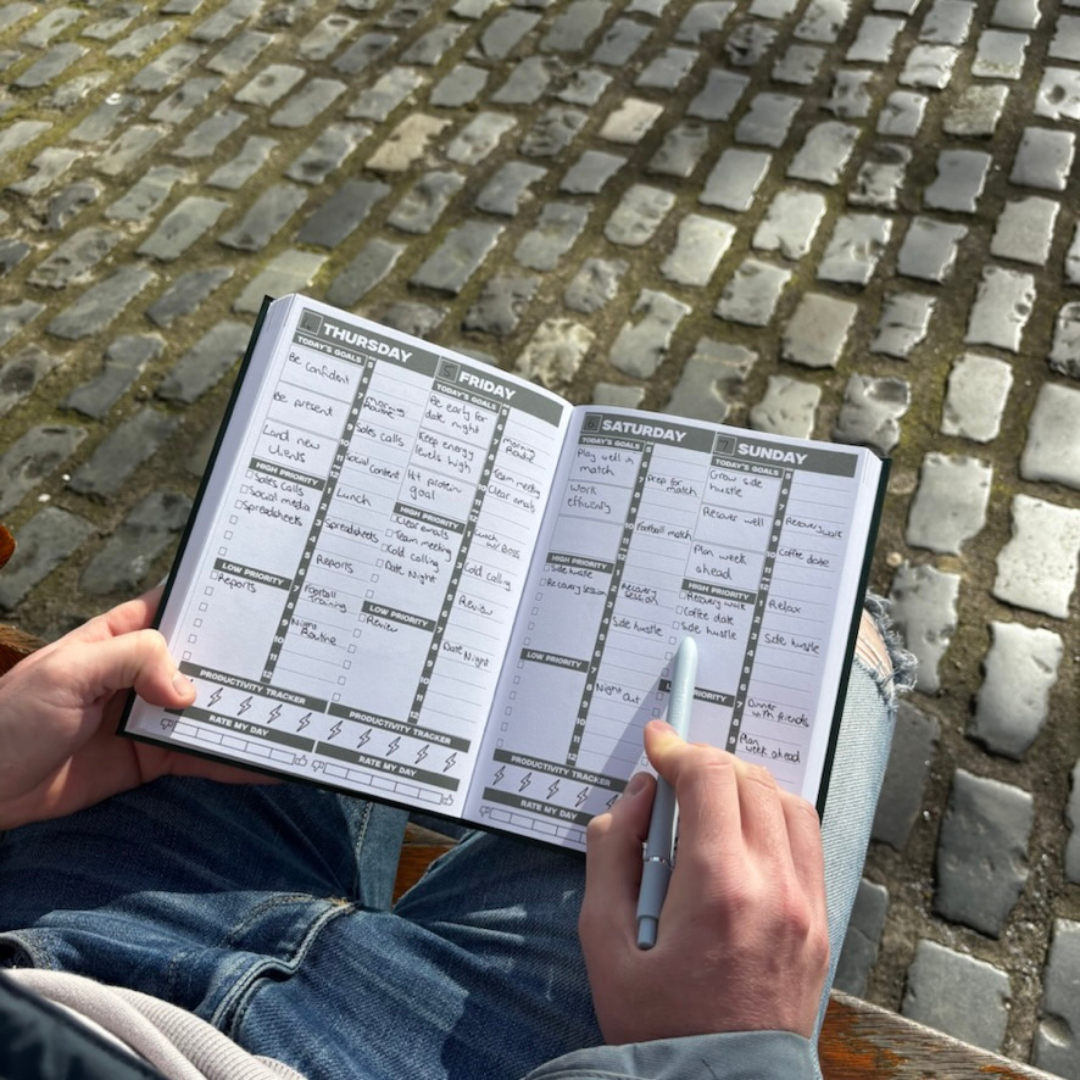
This is exactly the structure behind the Plan Your Growth undated weekly agenda, built with daily columns designed for time-blocked scheduling rather than a generic lined page that leaves you improvising the structure yourself. Because it is undated, a week that gets derailed by a genuine emergency does not mean starting the whole system over from a fresh dated page.
Batching Similar Tasks to Cut Switching Costs
Time blocking works best combined with batching, grouping similar low-intensity tasks into a single block rather than scattering them across the day between higher-value work. Email, admin, and quick approvals cost more than their surface-level time suggests when they interrupt a deep work block, because every interruption carries a refocusing cost on top of the interruption itself. Batching these into one or two fixed windows, rather than checking continuously, means the switching cost gets paid once per day instead of a dozen times. This single change, batching administrative tasks into defined blocks instead of leaving them open throughout the day, often recovers more usable time than any other single scheduling adjustment.
Defending the Blocks Once They Exist
A time block only works if it is defended the same way you would defend a client meeting. This means notifications off during deep work blocks, a closed door or a clear signal to colleagues, and a hard no to the instinct to check email "just for a second," which is rarely a second and almost always the end of the block's usefulness.
Build in buffer blocks between major tasks, fifteen minutes minimum, because tasks rarely finish exactly on schedule and a day with zero buffer collapses the first time anything runs long. The buffer is not wasted time. It is what keeps one delayed meeting from cascading into a ruined afternoon.
Adjusting Block Length as You Build the Skill
Men new to time blocking often overestimate how long they can sustain a single block of focused work, scheduling ninety-minute or two-hour blocks from day one and abandoning the method within a week when those blocks consistently fail. Attention under this kind of structure is trainable, not automatic, and starting with 25 to 45 minute blocks, extending only once that duration is reliably sustained without drift, builds the capacity gradually rather than demanding a level of sustained focus most men have not yet developed. This is not a lesser version of time blocking, it is the correct on-ramp to it.
Handling the Day That Refuses to Cooperate
Some days will not hold the plan. An emergency comes in, a meeting runs triple its scheduled time, and the beautifully blocked calendar is unrecognisable by 11am. The response is not to abandon time blocking, it is to re-block the remaining hours immediately rather than letting the rest of the day dissolve into reactive mode. A five-minute re-block, moving the highest-priority remaining task into whatever window is left, keeps the day structured even after it has already gone sideways.
This is the actual skill behind time blocking, not building the perfect schedule the night before, but rebuilding a functional one mid-crisis when the original plan has already failed.
Tracking Whether the Blocks Are Actually Working
A time blocking system that never gets evaluated tends to drift into unrealistic estimates without anyone noticing until deadlines start slipping consistently. A brief weekly check, comparing planned blocks against what actually happened, catches this drift early. If deep work blocks are getting interrupted three times a week by the same recurring issue, that is data worth acting on directly, whether it means renegotiating a meeting time, having a conversation about interruption norms, or simply admitting the block was scheduled at the wrong hour of the day. Treating the schedule as a system to refine, not a fixed plan to defend blindly, is what separates time blocking that improves over months from time blocking that gets abandoned after a few frustrating weeks.
The Bottom Line
Time blocking works because it removes the ambiguity that lets a day default to reactive mode. Every task gets a slot, the hardest task gets your best hours, and the blocks get defended like meetings because that is exactly what they are. When the plan breaks, which it will, the move is to re-block immediately, not abandon the system. Build tomorrow's blocks tonight, protect the first block of your day like it is the only one that matters, because most days it is.
The Plan Your Growth undated weekly agenda is built with the structure to make this daily, week after week, without needing a new system every time last week's plan gets thrown off. Build the habit once. Let the tool carry the weight of holding it, block after block, week after week, until the structure stops feeling like effort and starts feeling like how you naturally run a day.