The Weekly Review System That Keeps You on Track
Goals rarely die in a single dramatic failure. They die quietly, through weeks that pass without anyone checking whether the plan and the reality are still lined up. A weekly review system is the single habit that catches that drift before it becomes a pattern you don't notice until months of work have quietly gone sideways. Ask any man with an abandoned goal how it happened and the honest answer is rarely a crisis. It's usually a slow accumulation of unreviewed weeks.
Why Weekly, Specifically
A daily review is too granular to catch meaningful trends and too demanding to sustain long term. A monthly review is too infrequent to correct course before a small miss compounds into a larger one. Weekly sits at the exact frequency where you have enough data to spot a real pattern, not just a single bad day, while still being close enough to the problem to fix it before it grows. This is the same underlying logic behind the 12 week year framework's emphasis on weekly execution scoring: the week is the smallest unit of time that reliably reveals whether a plan is working.
There is also a practical rhythm argument. A week has a natural start and end point that most careers and lives already respect, whether that's a Sunday evening or a Monday morning. Building the review around that existing rhythm means you are not fighting your calendar to find the time. You are simply using a boundary that already exists.
The Four Questions Every Review Needs
What actually got done this week, against what was planned? Not a vague impression. Go through the specific tasks and priorities you set at the start of the week and mark each one honestly: done, partially done, or not started. This is the step most men skip because it can feel uncomfortable to confront a plan that didn't survive contact with the actual week, but skipping it is exactly what allows the same overestimation to repeat every single week without correction.
Why did the gaps happen? For anything not completed, spend a moment on the actual cause. Was the task poorly scoped, too large for the time available? Did something legitimately urgent displace it? Was it deprioritized in the moment for something that, in hindsight, didn't deserve the swap? This step turns a simple completion check into a genuinely useful diagnostic, because the same cause repeating week after week is the signal that something structural, not just a busy week, needs to change.
What are the one to three priorities for the coming week? Drawing directly from your longer-term goals, not from whatever feels most urgent in the moment. This is where the weekly review connects back to the bigger picture: a goal like a 12 week year target or a three-goal annual plan only stays alive if every single week's priorities are actually pulled from it, rather than drifting toward whatever email arrived most recently.
What needs to be blocked into the calendar to make those priorities real? A priority without a specific time slot is a wish. This final step converts the review from a reflective exercise into an actual plan, placing the coming week's priorities into specific blocks before Monday arrives, so execution starts immediately instead of requiring another round of decision-making once the week is already underway.
Where and When to Actually Do This
Same time, every week, treated with the same non-negotiable status as an important meeting. Sunday evening works well for most schedules because it sits ahead of the coming week with enough distance from the week just finished to think clearly. Whatever day you choose, consistency of timing matters more than the specific day, because a review that happens "whenever there's time" is a review that gets skipped the first genuinely busy week, which is precisely the week it would have been most valuable.
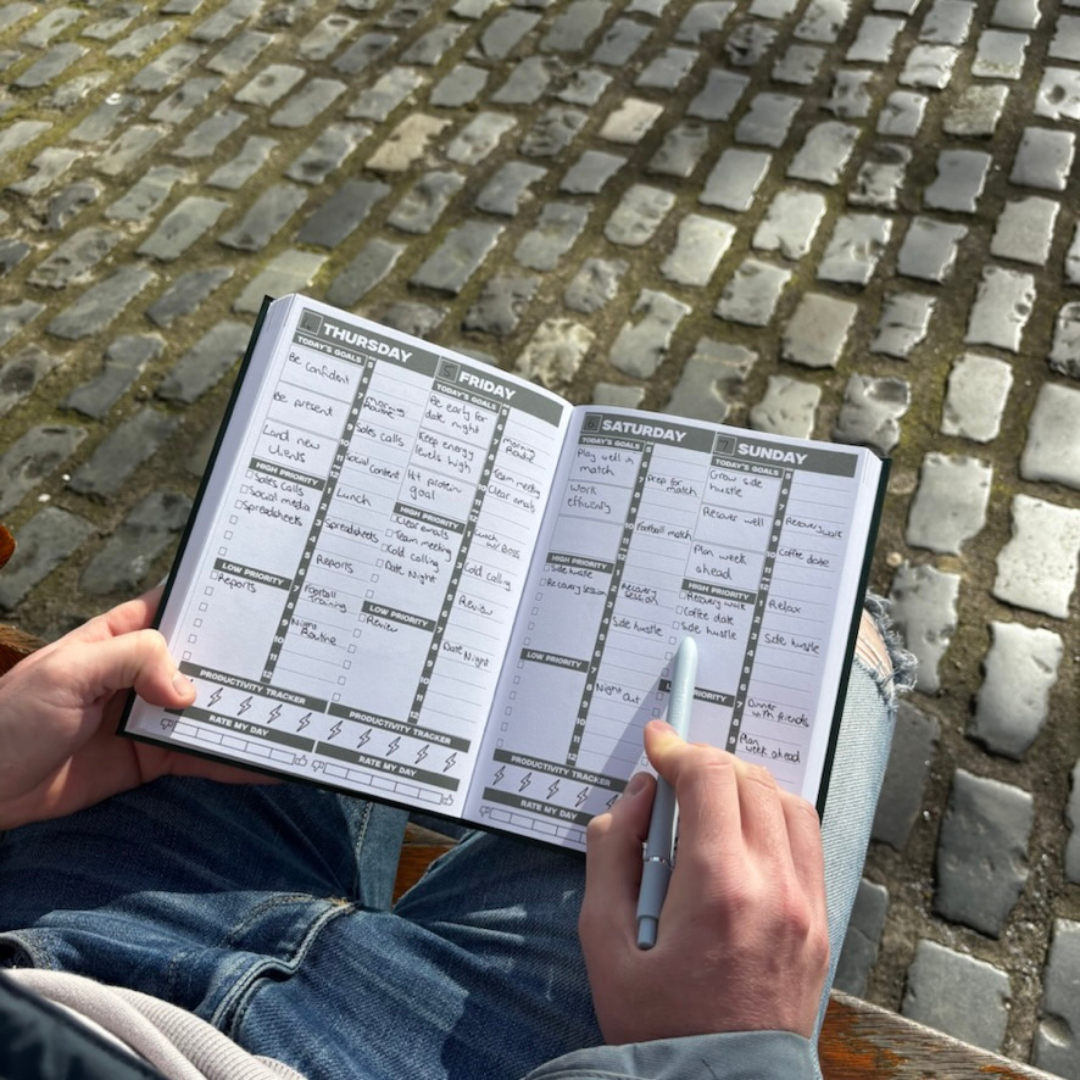
Do it on paper, not on a screen. A digital review competes with every other notification on the same device. It also loses the benefit of being able to flip back through previous weeks in seconds, spotting a pattern in your own handwriting that is far harder to notice scrolling through a digital calendar's list view. This is exactly why the weekly layout inside the Plan Your Growth undated weekly agenda is built around a single page per week: you can lay last week's plan next to this week's review, see the gap directly, and carry the pattern forward without hunting through separate digital entries.
Give it thirty to forty-five minutes. Less than that and the honest diagnostic step gets rushed. More than that and the review risks becoming its own form of procrastination, a comfortable ritual that delays actually starting the work it's supposed to set up.
What Undermines the System Over Time
The most common failure is letting the review slide the first time a weekend gets genuinely busy, telling yourself you'll "catch up" the following week. That catch-up rarely happens cleanly, and the gap compounds: two unreviewed weeks means twice the drift to diagnose, which makes the eventual review feel heavier and easier to avoid again. Protect the very first skipped week aggressively, because that is the moment the habit is most fragile.
The second failure is turning the review into a purely reflective exercise that never produces next week's actual block plan. A review that ends with insight but no calendar changes has diagnosed the problem without doing anything to fix it. Every review needs to end with specific blocks placed into the coming week, not just a mental note to "do better."
The third is reviewing only the tasks and skipping the why. A completion checklist tells you what happened. It does not tell you what to change. The diagnostic step, however uncomfortable, is what actually improves the system over time rather than just documenting the same pattern week after week without ever addressing its cause.
Connecting the Weekly Review to Bigger Goals
A weekly review disconnected from a longer-term goal becomes an exercise in managing the inbox, not building toward anything. Before your first review, make sure you have a clear picture of what the weeks are actually building toward, whether that's a 12 week year cycle, a set of three annual goals, or a specific project with a real deadline. Every week's priorities should trace back to that picture directly. If a week's top three priorities can't be connected to a goal that matters to you, that's worth noticing too, because it usually means the goal itself needs revisiting, not just the week's plan.
Reviewing With Someone Else
A weekly review does not have to be a solitary exercise, and for some men it works better when it isn't. Sharing a brief version of the review, what got done, what's planned next week, with a partner, an accountability friend, or a mastermind group adds a layer of external accountability that a private, unseen review cannot replicate on its own. Knowing someone else will ask how the week actually went changes how honestly the review gets conducted in the first place, particularly during the diagnostic step, where it's tempting to be generous with yourself when nobody else is checking.
This doesn't need to be elaborate. A two-line message to an accountability partner every Sunday evening, summarizing what got done and what's next, is enough to add the external layer without turning the review into a bigger production than it needs to be. The private, detailed version stays in your own planner. The shared version is just the headline, sent consistently, every week, to someone who will actually notice if it stops arriving.
Building the Habit When You've Never Done One Before
If you've never run a consistent weekly review before, don't start with the full four-question version above. Start with the single hardest habit first: simply sitting down at the same time every week and looking back at what happened, without judgment, for two or three weeks running. Once that basic sitting-down habit is solid, layer in the diagnostic question, then the forward planning, then the calendar blocking. Trying to run the full system perfectly in week one is a common reason the habit doesn't survive past week two. Build it in layers, the same way you would build any other new discipline.
What a Year of Weekly Reviews Actually Produces
A single weekly review is a modest exercise, thirty minutes, four questions, one page. Fifty-two of them, run consistently across a year, produce something a single planning session never could: a documented, honest record of an entire year's worth of plans against an entire year's worth of actual outcomes. Flip back through that record after twelve months and the value becomes obvious in a way it never is week to week. You'll see the projects that consistently ran over, the priorities that kept getting bumped, the season of the year your output reliably dips. That accumulated self-knowledge, built one honest week at a time, is worth considerably more than the sum of its individual thirty-minute sessions.
When the Review Reveals a Deeper Problem
Occasionally the weekly review surfaces something bigger than a single week's misfire, a goal that hasn't genuinely moved in two months, a pattern of the same excuse recurring every review. Don't let this get absorbed into the routine without a real response. A pattern that persists across four or more consecutive reviews is no longer a weekly execution problem. It's a signal that the goal itself, or the plan behind it, needs a harder look than a thirty-minute Sunday session can give it. Flag these patterns explicitly when you spot them, and schedule a separate, longer session to address the root issue rather than letting the same diagnosis repeat quietly, review after review, without ever being properly resolved.
The Bottom Line
A weekly review is the single habit that keeps a plan honest, and an honest plan is the difference between a goal that quietly dies from unreviewed drift and one that actually gets built, week by week, on purpose. Run it at the same time every week, on paper, and ask the four questions every time: what got done, why the gaps happened, what matters next week, and where it goes on the calendar. Protect the habit hardest in the exact weeks it feels least convenient, because those are the weeks it matters most.
The Plan Your Growth undated weekly agenda is built around exactly this rhythm: one page per week to plan, execute, and review, so the habit has a physical home instead of competing with a dozen apps for your attention. No printed dates, so your first review can start this Sunday, not the next one on an arbitrary calendar.