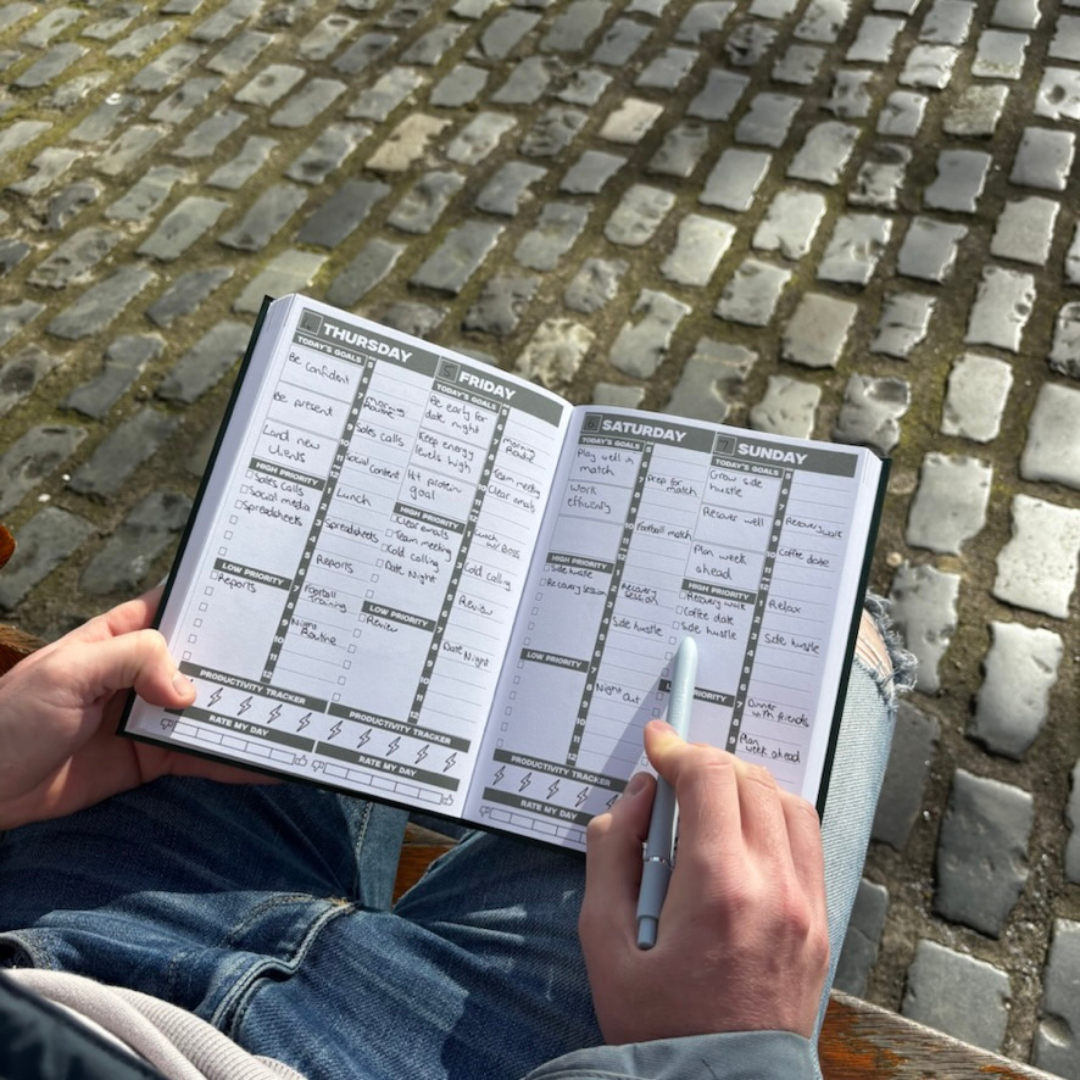
Time Blocking for Busy Professionals: The Complete System
Your day isn't crowded. Your attention is. The average knowledge worker switches tasks every few minutes and loses real focus time to every interruption, according to attention researcher Gloria Mark at UC Irvine. Time blocking for busy professionals is not a productivity hack. It is the structural recovery of hours you are already losing to a calendar that reacts instead of decides. If your to-do list survives the day untouched while your inbox runs your schedule, the problem was never your workload. It was the absence of a system.
What Time Blocking Actually Is
Time blocking means assigning every hour of your working day to a specific task or category, in advance, before the day starts. Not a loose list of priorities. A calendar where every block has a name and a job.
Most men run their day off a to-do list instead. Lists rank importance. They say nothing about when something happens or how long it should take. That gap is where your day gets hijacked. A list with ten items and no time attached will always lose to a meeting invite, a text, or the pull of your phone. A calendar block has a start time and an end time. It has a claim on the day that a list item does not.
The shift is simple to state and hard to run consistently: stop deciding what to do in the moment. Decide the night before or the morning of, in one sitting, and then execute against the plan instead of negotiating with yourself all day. This is the same principle behind the Plan Your Growth undated weekly agenda: the planning happens once, at the start of the week, so the execution can happen on autopilot for the other six days.
Building Your First Time-Blocked Week
Start with a weekly view before you touch a single day. Block the immovable items first: meetings you cannot shift, training, family commitments. These are the fixed points. Everything else gets built around them, not the other way round.
Next, identify your one to three highest-leverage tasks for the week. Not everything on your plate. The one to three things that would make the week a win if nothing else got done. Block these into your highest-energy hours, which for most men is the first two to three hours after they are fully awake, not the first two to three hours after they arrive at a desk.
Then block recovery. This is the step almost every man skips and the one that makes the rest of the system collapse without it. A day with zero white space is a day where the first delay cascades into every block after it. Fifteen-minute buffers between meetings are not wasted time. They are the shock absorbers that keep your 4pm block from starting at 4:40.
Finally, batch the small stuff. Email, admin, one-off requests. These do not deserve individual slots throughout the day. They deserve one or two dedicated blocks where you clear them in a batch, because context switching between deep tasks and shallow tasks is where most of your cognitive energy actually leaks out, not in the tasks themselves.
Why Most Time Blocking Fails Inside Two Weeks
Men who try time blocking usually fail for one of three reasons, and all three are fixable.
The first is over-scheduling. They block every single minute with zero slack, and the first unplanned interruption, which is guaranteed to happen, blows up the entire day and they abandon the system by Wednesday. Build in fifteen to twenty percent slack on any given day. That is not weakness. That is realism.
The second is planning in the wrong place. A to-do app on your phone competes with every other app on your phone for your attention while you are supposed to be planning. A physical system removes that friction entirely. This is exactly why an undated, physical weekly agenda works better for this specific job than a digital calendar app: there is no notification pulling you sideways while you are trying to build the week, and the physical act of writing a block down creates a level of commitment that dragging a digital event never does.
The third failure point is treating the block as a suggestion instead of a boundary. If a colleague can pull you out of a deep work block for something that could wait until your batch-processing block, the system was never really running. You have to protect the block the same way you would protect a client meeting, because to you, right now, it is one.
Cal Newport, the Georgetown professor whose research on focused work has shaped how a generation of professionals think about their calendars, argues that the ability to concentrate without distraction is becoming both increasingly rare and increasingly valuable. Time blocking is the delivery mechanism for that skill. Without a block, deep work does not happen by accident. It gets crowded out by whatever is loudest in the moment.
Time Blocking for a Realistic Work Week
Here is a template you can adapt starting Monday.
Morning block, sixty to ninety minutes: your single highest-leverage task, done before email or Slack is opened. No exceptions on this one. The first hour sets the tone for every hour after it.
Mid-morning block: meetings, calls, collaborative work. Your energy is still high but your focus is now split across people, which suits this kind of task better than solo deep work.
Early afternoon block: a second deep work session if your role allows it, or your second-highest-leverage task if not. Energy typically dips here, so match the task difficulty to what you can realistically sustain.
Late afternoon block: batch processing. Email, admin, follow-ups, the accumulated small tasks from the day. Set a hard end time so this does not bleed into your evening.
Close of day: a five-minute shutdown where you review what got done, move anything unfinished into tomorrow's blocks, and close the loop mentally so work does not follow you home. If you want the fuller version of this habit, the Plan Your Growth undated weekly agenda has a daily shutdown prompt built into every page for exactly this purpose.
Tracking What Actually Works
A time-blocking system that is not reviewed will drift within a month. Every Sunday, look back at the week. Which blocks held? Which got blown up every single time? A block that fails three weeks running is not a discipline problem. It is a design problem, and the fix is usually to either move it to a different part of the day or shrink it to a length you will actually protect.
This is where most digital tools fall short and a physical undated agenda earns its place. You can flip back three or four weeks in seconds and see the pattern in your own handwriting: the block you keep skipping, the day that keeps overrunning, the habit that is actually sticking. That kind of pattern recognition over paper is faster and more honest than scrolling a calendar app looking for a trend that is not visually obvious.
Time Blocking Across Different Roles
The core mechanics stay the same across roles, but the shape of the week changes depending on how much of your calendar you actually control. A founder or freelancer with genuine control over their schedule can protect large, uninterrupted deep work blocks most mornings. A manager with a calendar full of other people's meetings needs a different approach: instead of hunting for large open blocks, protect smaller, non-negotiable islands, forty-five minutes here, an hour there, and treat them as fixed points that meetings get scheduled around, not the reverse.
The mistake most men in meeting-heavy roles make is assuming time blocking doesn't work for them because their calendar isn't their own. It still works. It just has to run in reverse: instead of blocking deep work and filling gaps with meetings, you block the meetings first as fixed, then defend whatever is left with the same seriousness you would give an external commitment. A single protected forty-five-minute block on a chaotic Tuesday is still worth more than an unprotected three hours that gets fragmented into nothing.
Shift workers and men with irregular schedules face a different problem: there is no consistent "morning" to anchor the highest-leverage block to. The fix here is anchoring to your personal energy pattern instead of the clock. Track your focus levels for a week regardless of what time they occur, and you will usually find a consistent one to three hour window where your concentration is reliably highest, whether that falls at 6am or 9pm. Block your hardest work there, whatever the actual hour on the clock says.
Tools Versus Discipline
A common objection to time blocking is that it requires the right app or system to work. It doesn't. The system fails or succeeds based on whether the blocks get protected, not on which tool holds them. A paper agenda with a block written in pen and genuinely respected will outperform a perfectly color-coded digital calendar that gets overridden by the first meeting request that lands in your inbox.
This is worth stating plainly because a lot of men spend more time optimizing their planning tool than actually planning. If you have spent more than an hour this month comparing productivity apps, that time would have produced more value spent simply blocking next week on paper and holding the blocks. The tool is not the constraint. The follow-through is.
Handling the Interruption You Can't Say No To
Even with a well-protected calendar, some interruptions genuinely cannot wait, a client emergency, a family matter, a real deadline shift. The system doesn't need to be abandoned when this happens. It needs a recovery step: when a block gets blown up, don't try to cram the displaced task into the next open slot on the same day. That approach cascades the disruption through the rest of your afternoon. Instead, explicitly reschedule the displaced block to a specific slot later in the week during your next planning check-in, and let the rest of the day continue as planned around the interruption rather than around a rushed attempt to fit everything back in immediately. A calendar that flexes around one disruption without collapsing entirely is a resilient system. One that requires perfect adherence to survive was never going to last past the first hard week anyway.
The Bottom Line
Time blocking works because it replaces in-the-moment decision-making with a plan you committed to in advance, when you had more clarity and less pressure than you will have at 2pm on a Tuesday. Build your week around your one to three highest-leverage tasks, protect your best hours for your hardest work, batch the small stuff, and leave enough slack that one delay does not take down the whole day. Do it on paper, review it every Sunday, and give it a month before you judge whether it works.
If you are ready to stop planning in your head and start planning on paper, the Plan Your Growth undated weekly agenda is built for exactly this system: a weekly layout with room to block your day, a daily shutdown prompt to close the loop, and no dates printed in, so you start the week you pick it up instead of losing three days to a January 1st that already passed.