Time Blocking: How to Structure a Day That Actually Executes
Your day isn't crowded. Your calendar is empty and your to-do list is full, and those are two very different problems. A to-do list tells you what needs doing. It never tells you when, which means every task on it competes for the same unscheduled, unprotected hours, and the loudest task wins by default. Time blocking closes that gap by assigning every task a specific slot on the clock, turning a list of intentions into an actual schedule you execute against instead of negotiate with all day.
Why a To-Do List Alone Fails You
A to-do list is a container for tasks, not a plan for completing them. Ten items on a list carry equal visual weight regardless of how important or time-consuming they actually are, which means your brain defaults to whichever feels easiest or most urgent in the moment, not whichever moves your goals furthest. This is how a day disappears into email and quick wins while the one task that actually mattered never gets touched.
Computer scientist Cal Newport, who has written extensively on time blocking as a core productivity method, argues that the practice works because it forces a decision most people avoid: deciding in advance exactly when a task will happen, not just that it needs to happen eventually. A task with no scheduled time is, functionally, a task with no real commitment behind it. It exists as a hope, not a plan.
Time blocking removes that ambiguity entirely. Every hour of your working day gets assigned to something specific, deep work, meetings, admin, even breaks. Nothing floats. When 9am arrives, you already know what 9am is for, and that certainty alone eliminates a huge amount of the decision fatigue that quietly drains your energy before lunch.
Building Your First Time-Blocked Day
Start the night before or first thing in the morning, not mid-morning after the day has already started pulling you in different directions. List your non-negotiables for the day, the two or three tasks that would make the day genuinely successful if completed. These get scheduled first, in your highest-energy window, before anything else claims that time.
Next, block your known fixed commitments: meetings, calls, appointments. These are not optional and go in exactly as scheduled. What remains is the raw material for your discretionary blocks.
Assign specific time slots to everything else: admin and email in a batched window rather than scattered throughout the day, a block for reactive work, and critically, buffer time between blocks. A day scheduled to the minute with zero slack collapses the first time a meeting runs long, and one blown block cascades into a blown afternoon. A 15 to 30 minute buffer between major blocks absorbs the inevitable overrun without destroying the rest of your plan.
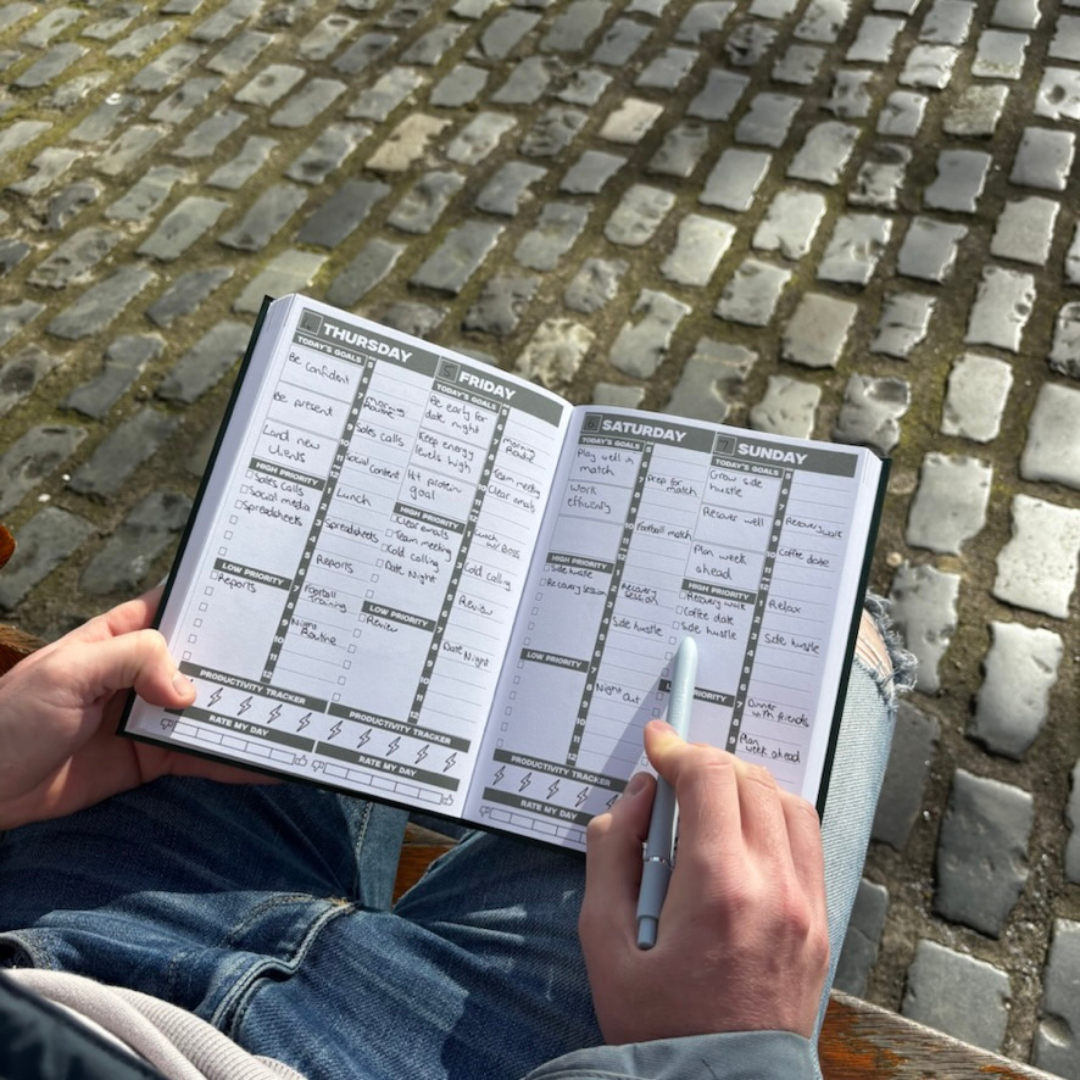
The Plan Your Growth undated weekly agenda is built around exactly this structure, giving each day a visible block layout so the plan lives on paper in front of you rather than as a mental note that dissolves the moment something urgent shows up.
The Case for Batching Similar Work
One of the most effective time-blocking upgrades is batching: grouping similar tasks into a single block instead of scattering them across the day. Email is the clearest example. Checking it continuously throughout the day means constant context switching, and research on attention residue, the cognitive cost of shifting between unrelated tasks, consistently finds that each switch carries a measurable penalty in focus and speed on the task you just left.
Instead, block two or three fixed windows a day for email and quick communications, and treat everything outside those windows as off-limits for that kind of work. The same principle applies to calls, admin, and any other category of task that tends to interrupt deep work when left unscheduled. Batching does not eliminate the work. It concentrates the cost of switching into a few deliberate moments instead of paying it dozens of times a day without noticing.
Protecting Deep Work Blocks From Erosion
The single biggest threat to time blocking is other people's requests eroding your scheduled deep work before it even starts. A block on your calendar means nothing if you cave the moment a colleague asks for "just five minutes." Those five minutes reliably cost more than five minutes once the interruption and the recovery time are counted, since researcher Gloria Mark's work at UC Irvine on attention found that resuming a task after an interruption takes significantly longer than most people assume, often over twenty minutes to fully regain the same depth of focus.
Protecting your blocks requires a small amount of upfront friction: closing your door if you have one, using a status indicator on communication tools, or simply telling the people around you which hours are protected. This feels awkward the first few times. It becomes normal within a couple of weeks, and the payoff, actually finishing deep work instead of constantly restarting it, is worth the initial discomfort.
Adjusting the Plan Without Abandoning It
Time blocking fails for a lot of men not because the method is flawed, but because the first disrupted day convinces them the whole system does not work for their life. A meeting runs over, a client calls unexpectedly, and the beautifully blocked schedule falls apart by 11am. The instinct is to abandon the plan entirely and drift through the rest of the day reactively.
The better move is to re-block, not abandon. When something disrupts your schedule, take two minutes to look at what remains of the day and rebuild the blocks around the new reality, rather than letting one disruption cascade into a fully unstructured afternoon. This is a skill that improves with repetition. The first few re-blocks feel clunky. By the tenth, it takes under a minute and becomes second nature.
The Bottom Line
A to-do list tells you what to do. Time blocking tells you when, and that single addition is the difference between a day full of good intentions and a day that actually executes. Block your non-negotiables first, in your highest-energy hours. Batch similar tasks instead of scattering them. Protect deep work blocks with real boundaries. When disruption hits, re-block instead of abandoning the plan entirely. Structure beats motivation on the days motivation does not show up, which is most days.
The Plan Your Growth undated weekly agenda gives your time blocks a real page to live on, visible all day instead of buried in an app you forget to check. Build the blocks once each morning. Let the schedule carry the execution from there.