Time Blocking: The Weekly Planning System That Actually Works
The average knowledge worker switches tasks every 47 seconds, and it takes roughly 23 minutes to fully refocus after each interruption. That is not a schedule problem. That is what an unstructured week does to your attention. Time blocking is the weekly planning system that stops that bleed. Not by adding more hours, but by deciding, in advance, exactly what each hour is for. Most men skip this step and then wonder why they finish Friday exhausted and behind. This post gives you the mechanism.
Why Your Current Calendar Is Lying to You
A calendar with meetings and rough to-do lists is not a plan. It is a suggestion. Most men look at their week and see open space as opportunity, when in reality it is where their best hours go to die. Without structure, you default to the urgent over the important, the reactive over the intentional. You end the week having done plenty but advanced nothing.
The problem is not your work ethic. It is that you are navigating without a map and expecting to arrive somewhere precise. Time blocking removes that ambiguity. Every block of time has a single owner: one task, one type of work, one outcome. When the block is on your calendar, you do not decide what to work on. That decision was already made.
This distinction matters more than it sounds. Decision fatigue is real. Research from Gloria Mark at the University of California, Irvine has shown that even micro-interruptions, the kind you barely notice, compound into hours of lost deep focus across a week. Time blocking is not a productivity optimisation. It is the structural recovery of those hours.
How to Build a Time Blocking System That Holds
Start with your fixed commitments. Meetings, calls, standing obligations. Drop them in first. These are the rocks. Now look at what remains.
Identify your three categories of work. Deep work (creation, strategy, complex problem-solving), shallow work (admin, email, quick decisions), and maintenance (exercise, meal prep, commute). Each needs its own block type. Do not mix them.
Assign your highest-cognitive blocks to your peak hours. For most men this is the first two to three hours of the morning. Guard these aggressively. No meetings. No inbox. No social media. This is where the work that actually moves your life forward gets done.
Stack shallow work into one or two contained windows later in the day. The goal is batching: you deal with email once at 1:00 and once at 4:30, not every nine minutes. The same principle applies to admin, scheduling, and any task that does not require sustained concentration.
Leave buffer blocks. Thirty-minute gaps between major blocks let the real world breathe. Things overrun. Decisions take longer than planned. Without buffer, your whole system collapses by 10:30 on Monday.
The Weekly Planning Session: When the System Gets Built
Time blocking only works if you build the blocks before the week starts. That means a dedicated weekly planning session, ideally Sunday evening or first thing Monday morning, before you open email or check messages.
The session has four steps. First, review last week. What finished? What carried over? What did you learn about how your time actually moved versus how you intended it to move? This is not self-criticism. It is calibration data.
Second, identify your three to five must-complete outcomes for the coming week. Not tasks. Outcomes. "Finish the Q3 proposal draft" is an outcome. "Work on proposal" is a wish.
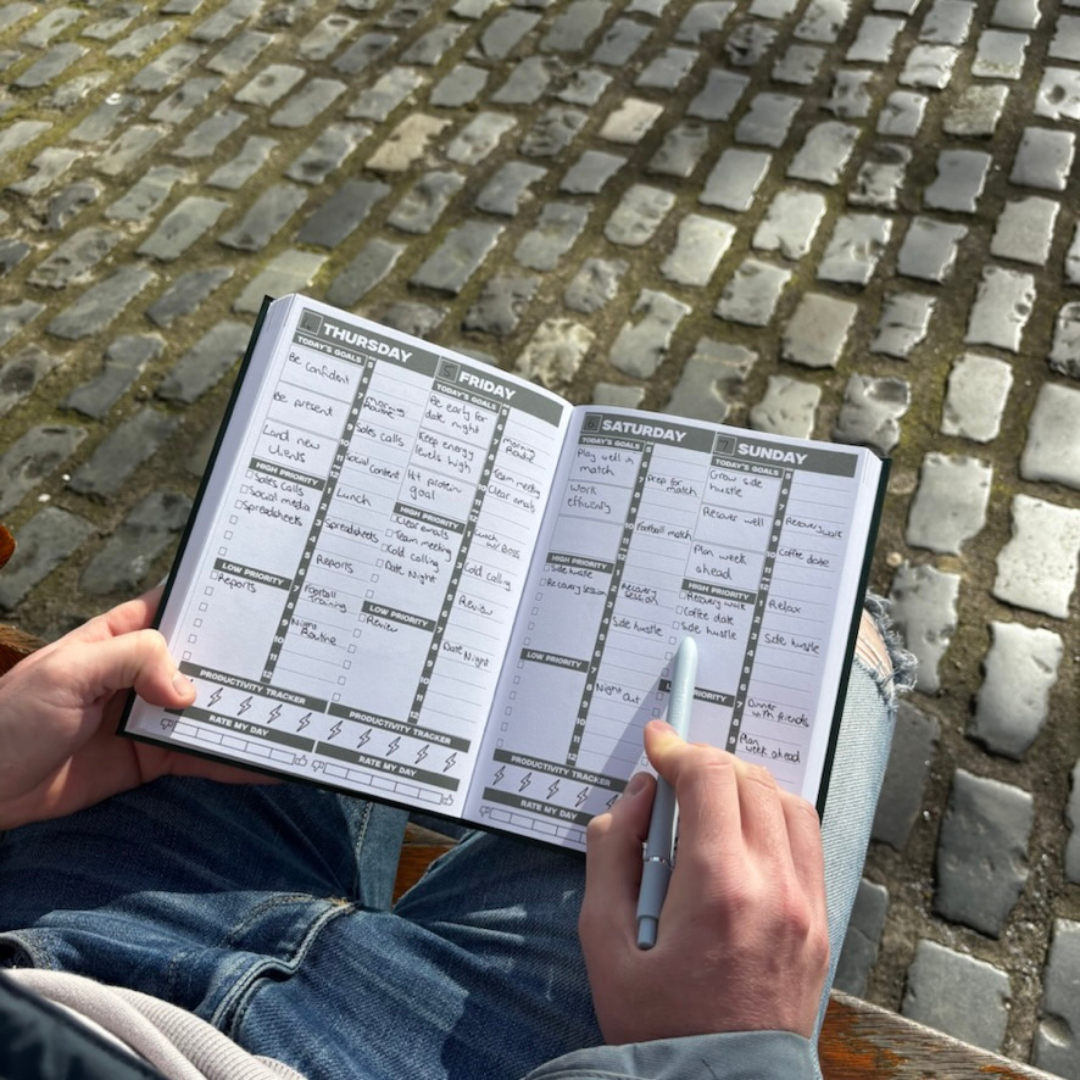
Third, assign each outcome to a specific time block. Open your calendar, find the space, and book it. The Plan Your Growth undated weekly agenda is built around exactly this workflow: a structured spread that lets you map your week against your priorities before it starts, not while it is already moving.
Fourth, protect the blocks. Tell people you are unavailable. Put your phone in another room. Treat your deep work blocks the way you would treat a meeting with a client you cannot afford to lose.
The Most Common Reasons Men Abandon Time Blocking
It feels rigid. It is not. The blocks define the type of work, not every micro-decision inside the block. You are not scheduling your thoughts. You are scheduling the conditions for your best thinking.
The day went sideways, so the system broke. One derailed day is not a failed system. It is Tuesday. The answer is not to abandon the blocks. It is to have a recovery protocol: a short reset at midday or end of day where you quickly reassign what moved, what dropped, and what still needs a home.
They tried to run the system in their head. This is the one that kills most attempts. A system that lives only in your memory is not a system. It is intention. Intentions dissolve under pressure. The block needs to exist somewhere physical: a calendar, a planner, a written spread that you can actually look at.
What Time Blocking Does to Your Long-Term Trajectory
Run a tight time-blocking system for 90 days and something changes. You start to see your time accurately. You understand, in concrete terms, how long things actually take versus how long you thought they would. You stop overbooking. You start finishing.
More importantly, you develop evidence. You can look back at any week and tell exactly where your hours went. That visibility is the beginning of genuine control over your output. Most men operate on vibes: the sense that they worked hard, that they gave it their all. Time blocking replaces vibes with data.
That data compounds. When you know your actual capacity, you make better commitments. When you make better commitments, you deliver more consistently. When you deliver consistently, the people around you trust you more. The trajectory shifts from "always busy, rarely advancing" to "clear, focused, moving."
The Bottom Line
Time blocking is not a calendar hack. It is the structural difference between a week that executes against your priorities and a week that just happens to you. The mechanism is simple: assign every significant block of time a single owner before the week starts, protect deep work hours from interruption, batch shallow work into contained windows, and run a weekly planning session that reviews the last seven days and builds the next seven. Do that consistently for 90 days and your relationship with your own time will be unrecognisable.
If you want a physical tool built around exactly this workflow, the Plan Your Growth undated weekly agenda gives you a weekly spread designed to hold your blocks, track your outcomes, and keep the system visible. You cannot manage what you cannot see.